
Home / Research Articles / Ipamorelin: The Selective Growth Hormone Secretagogue
Ipamorelin: The Selective Growth Hormone Secretagogue
Key Takeaways
- Ipamorelin is a synthetic pentapeptide (5 amino acids) and one of the most selective growth hormone secretagogues identified to date.
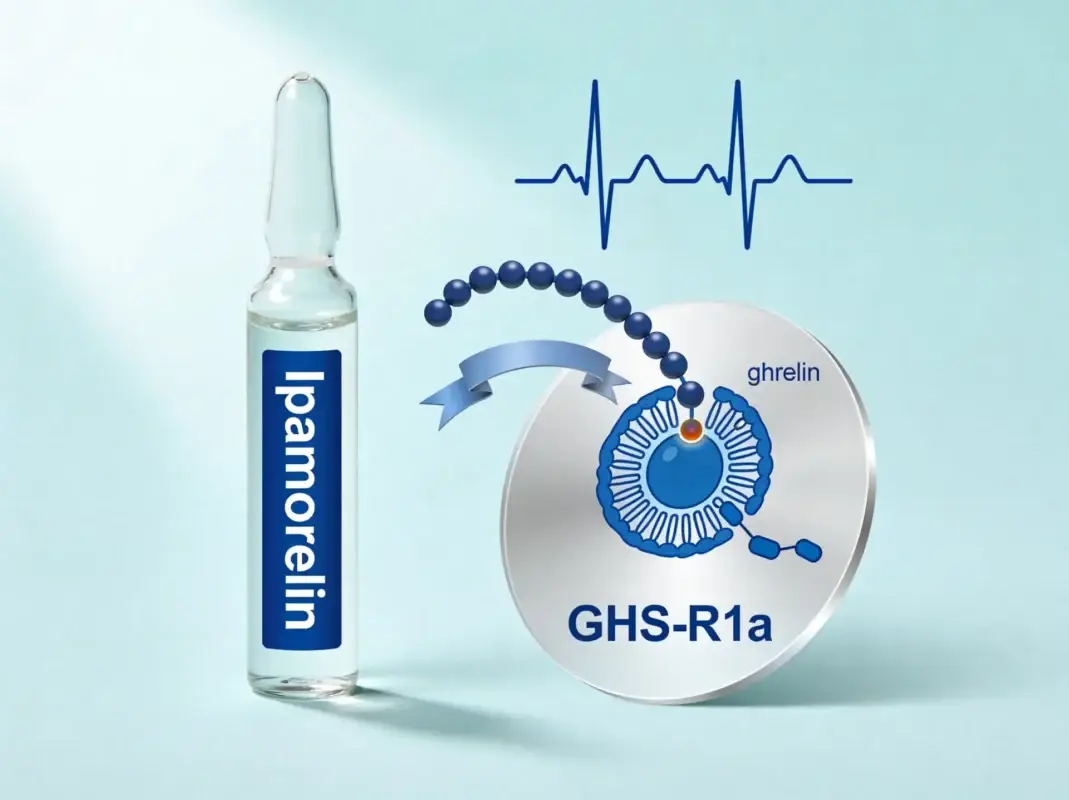
- Unlike CJC-1295 (which acts on the GHRH receptor), Ipamorelin acts on the ghrelin receptor (GHS-R1a) — a separate upstream pathway converging on growth hormone release.
- The compound's defining feature is its selectivity: it stimulates GH release with minimal effect on cortisol, prolactin, or aldosterone, unlike earlier growth hormone-releasing peptides.
- Ipamorelin is commonly studied in combination with GHRH analogs such as CJC-1295, since the two compound classes activate distinct pathways and produce synergistic GH release.
- Ipamorelin is not approved for human therapeutic use by any regulatory agency and is intended exclusively for laboratory research.
Ipamorelin occupies a particular niche in growth hormone research: it is one of the few growth hormone-releasing peptides (GHRPs) selective enough that researchers can study GH/IGF-1 dynamics without simultaneously activating the cortisol, prolactin, or aldosterone axes. That selectivity matters more than it might first appear — earlier GHRPs such as GHRP-2 and GHRP-6 produce GH release reliably but also elevate cortisol and prolactin, which confounds research designs trying to isolate GH effects. Ipamorelin was developed specifically to address that problem.
This article addresses Ipamorelin as a research compound, covering its structural origins, the ghrelin receptor mechanism that distinguishes it from GHRH analogs like CJC-1295, the research applications where its selectivity is particularly useful, and the reconstitution and sourcing considerations researchers should understand before working with the compound.
What Is Ipamorelin?
Ipamorelin is a synthetic pentapeptide — a chain of just five amino acids — with the sequence Aib-His-D-2-Nal-D-Phe-Lys-NH₂. The molecular weight is approximately 711.86 g/mol, and the CAS registry number is 170851-70-4. The compound’s small size and non-natural amino acid composition make it structurally distinct from the larger naturally-derived peptides in the GH research class.
Ipamorelin was discovered and characterized by researchers at Novo Nordisk in the late 1990s, with the foundational paper published by Raun and colleagues in 1998 in the European Journal of Endocrinology [Ref. 1]. That paper introduced Ipamorelin as the first growth hormone secretagogue with the selectivity profile that would become its defining feature: robust GH release with minimal effect on adrenocorticotropic hormone (ACTH), cortisol, prolactin, or aldosterone secretion.
The compound’s half-life in circulation is approximately two hours, substantially longer than first-generation GHRPs and shorter than fatty-acid-modified compounds like CJC-1295 with DAC. This intermediate half-life produces a sustained-but-not-prolonged GH response that aligns well with typical research protocols.
Ipamorelin is not approved for human therapeutic use by any regulatory agency. Despite reaching phase 2 clinical trials for postoperative ileus in the early 2000s, the compound was not advanced to approval and remains in research-only status.
Mechanism of Action
Ipamorelin is a ghrelin receptor agonist. It binds the growth hormone secretagogue receptor type 1a (GHS-R1a) — a G-protein-coupled receptor expressed on somatotroph cells in the anterior pituitary and on hypothalamic neurons that regulate GH release. This is a fundamentally different mechanism from GHRH analogs like CJC-1295, which act on a separate receptor (GHRH-R). The two pathways converge on GH release at the pituitary but originate from independent upstream signals.
The GHS-R1a receptor is the same receptor activated by ghrelin, the endogenous peptide secreted from the stomach that signals hunger and stimulates GH release. Ipamorelin mimics ghrelin’s effect at this receptor without sharing ghrelin’s full pharmacological profile.
What makes Ipamorelin notable in this class is its receptor selectivity. Other GHRPs that activate GHS-R1a — including GHRP-2, GHRP-6, and hexarelin — also produce significant elevations in cortisol, ACTH, and prolactin. Ipamorelin was specifically designed to minimize these off-target effects, and the foundational pharmacology work demonstrated GH release without parallel cortisol or prolactin elevation across the dose range tested [Ref. 1, Ref. 3].
The synergy with GHRH analogs follows directly from the distinct receptor pathways. When a GHRH agonist (CJC-1295) and a ghrelin receptor agonist (Ipamorelin) are administered together, the somatotroph receives two independent upstream signals that converge on GH release. The combined response is larger than either compound produces alone — a pharmacodynamic interaction frequently exploited in GH-axis research [Ref. 4].
A 2001 review by Veldhuis and Bowers in Growth Hormone & IGF Research synthesizes the broader pulsatile GH secretion biology that contextualizes both single-agent and combination research with Ipamorelin [Ref. 5].
Research Applications
Ipamorelin research clusters into several primary domains, with the compound’s selectivity making it particularly useful where confounding hormonal effects need to be minimized.
Growth hormone and IGF-1 axis research
This is the core research application. Ipamorelin is used to stimulate GH release in animal models and in vitro systems for studies of GH secretion dynamics, downstream IGF-1 production, and somatotroph cell behavior. Its selectivity means researchers can attribute observed effects to GH/IGF-1 elevation without confounding cortisol or prolactin elevation.
Combination studies with GHRH analogs
Research on synergistic GH release commonly combines Ipamorelin with a GHRH agonist such as CJC-1295. Because Ipamorelin acts on the ghrelin receptor and CJC-1295 acts on the GHRH receptor, the two compounds activate independent upstream pathways that converge at the pituitary. The combined response amplifies GH release beyond what either compound produces alone. A dedicated CJC-1295 + Ipamorelin protocol article is forthcoming.
Bone density research
A body of work has examined Ipamorelin’s effects on bone parameters, with studies dating back to the early 2000s investigating bone mineral density, bone formation markers, and osteoblast activity in animal models [Ref. 2]. The mechanism is believed to involve both direct GH/IGF-1 effects on bone and possibly direct GHS-R1a effects on bone-forming cells, though the latter pathway remains an active research question.
Body composition and metabolic research
Studies have examined effects on lean mass, fat mass, and metabolic parameters in animal models, generally as part of the broader literature on GH secretagogues. Results depend heavily on protocol design and the choice between Ipamorelin monotherapy and combination protocols.
Related growth hormone research
The broader GH peptide literature includes the only approved compound in this general class, Tesamorelin, a GHRH analog approved for HIV-associated lipodystrophy. Tesamorelin acts through a different receptor than Ipamorelin but produces overlapping downstream GH/IGF-1 effects, providing useful clinical context for Ipamorelin research interpretations [Ref. 4].
Across all research domains, Ipamorelin is intended for laboratory research only. The compound has not been evaluated by any regulatory agency for human therapeutic use.
Dosing & Reconstitution for Research
Researchers working with lyophilized Ipamorelin reconstitute the compound with bacteriostatic water before use. The basic reconstitution math follows the standard concentration-equals-mass-divided-by-volume principle.
A 5 mg vial of Ipamorelin reconstituted with 2 mL of bacteriostatic water yields 2.5 mg/mL. A 10 mg vial in 2 mL yields 5 mg/mL. Ipamorelin’s relatively small molecular weight (711.86 g/mol) means molar concentrations are much higher per mg than for the larger GH peptides — a 5 mg vial contains approximately 7,030 nmol, compared to roughly 1,500 nmol for a 5 mg vial of CJC-1295.
Reconstitution technique is standard: inject bacteriostatic water down the inner wall of the vial rather than directly onto the lyophilized powder, then swirl gently until dissolved. Direct injection onto powder can cause foaming and may complicate accurate concentration measurement.
Researchers running combination protocols with CJC-1295 typically reconstitute the two compounds in separate vials rather than combining them pre-reconstitution. This preserves the ability to verify each compound’s identity and concentration independently.
Researchers can verify their concentration math against our peptide reconstitution calculator, which handles the conversion automatically.
This article does not provide dosing guidance for any therapeutic purpose. Ipamorelin is not approved for human therapeutic use.
Storage & Handling
Lyophilized Ipamorelin is stable at room temperature during shipping but should be moved to long-term storage at -20°C (-4°F), protected from light, on receipt. Under proper lyophilized conditions, the compound remains stable for 24 months or longer.
Once reconstituted, Ipamorelin should be stored at 2–8°C and used within 28 days. Repeated freeze-thaw cycles degrade peptide integrity and should be avoided.
Researchers planning to draw from a reconstituted vial across multiple sessions should consider aliquoting into smaller volumes immediately after reconstitution to minimize freeze-thaw exposure of the working stock.
Every vial should be visually inspected before use. The reconstituted solution should be clear and free of particulates. Cloudiness, discoloration, or visible sediment indicates degradation, and the vial should not be used in research.
For full handling protocols across the broader peptide catalog, see our storage and reconstitution guide.
Sourcing Verified Ipamorelin for Research
Ipamorelin’s small size makes mass spectrometry verification particularly straightforward — the expected molecular weight of approximately 712 Da is small enough to be measured with high accuracy on standard analytical equipment, and it is distinct enough from related GHRPs (GHRP-2 at ~817 Da, GHRP-6 at ~872 Da, hexarelin at ~887 Da) that mislabeling within the GHRP class is easy to detect with proper testing.
A credible Certificate of Analysis for Ipamorelin should show HPLC purity expressed as a percentage, mass spectrometry confirmation matching ~712 Da, and a clear distinction between peptide content and peptide mass.
Kinetic Compounds tests every batch of Ipamorelin through Janoshik Analytical, an independent third-party laboratory, with current batch reports published on the Ipamorelin product page. Our broader testing methodology is documented on our lab testing and COA page.
For researchers running combination protocols, CJC-1295 (with DAC) and CJC-1295 no DAC are the most commonly paired compounds with Ipamorelin in GH-axis research. The full growth hormone research peptide catalog lists all related compounds.
Researching the growth hormone axis? Our complete growth hormone research peptide catalog covers Ipamorelin, CJC-1295, Tesamorelin, and related compounds — all independently lab-tested with current Certificates of Analysis available.
Related Peptides
Related peptides will load here via PHP snippet.
Available for Research
Research Tools
Quality Promise
very batch independently tested by Janoshik Analytical. 98% purity minimum.
Frequently Asked Questions
What is Ipamorelin?
<p>Ipamorelin is a synthetic pentapeptide (5 amino acids) and a selective ghrelin receptor agonist. It was developed by Novo Nordisk in the late 1990s as a growth hormone secretagogue designed to stimulate GH release without elevating cortisol, prolactin, or aldosterone. It is not approved for human therapeutic use.</p>
How is Ipamorelin different from CJC-1295?
<p>CJC-1295 acts on the growth hormone-releasing hormone (GHRH) receptor. Ipamorelin acts on the ghrelin receptor (GHS-R1a). The two compounds activate distinct upstream pathways that converge on growth hormone release at the pituitary, which is why combination protocols produce synergistic effects.</p>
Why is Ipamorelin called "selective"?
<p>Ipamorelin selectively stimulates growth hormone release without significantly elevating cortisol, prolactin, ACTH, or aldosterone. Earlier growth hormone-releasing peptides (GHRP-2, GHRP-6, hexarelin) elevate these other hormones along with GH, which complicates research designs trying to isolate GH effects. Ipamorelin was specifically designed to avoid these off-target effects.</p>
Can Ipamorelin be combined with CJC-1295?
<p>Combination protocols using CJC-1295 and Ipamorelin are common in growth hormone research because the two compounds activate distinct upstream pathways converging on GH release. The combination is studied for synergistic activation of the GH axis. A dedicated CJC-1295 + Ipamorelin protocol article is forthcoming.</p>
How is Ipamorelin reconstituted for research?
<p>Lyophilized Ipamorelin is reconstituted with bacteriostatic water. A 5 mg vial in 2 mL of bacteriostatic water yields 2.5 mg/mL. Because Ipamorelin's molecular weight is small (~712 g/mol), molar concentrations are higher per mg than for larger GH peptides. Researchers can verify calculations using our reconstitution calculator.</p>
Is Ipamorelin legal in Canada?
<p>Research-grade Ipamorelin is legal to purchase and possess in Canada for laboratory research purposes only. The compound is not approved by Health Canada for human therapeutic use.</p>
Where can I find a Certificate of Analysis for Ipamorelin?
<p>Kinetic Compounds publishes batch-specific Certificates of Analysis from Janoshik Analytical on the Ipamorelin product page. COAs can also be requested directly via research@kineticcompounds.com.</p>
References
- "Ipamorelin, the first selective growth hormone secretagogue." European Journal of Endocrinology, 139(5):552-561. — Raun K, Hansen BS, Johansen NL, Thøgersen H, Madsen K, Ankersen M, Andersen PH (1998).
- "The growth hormone secretagogue ipamorelin counteracts glucocorticoid-induced decrease in bone formation of adult rats." Growth Hormone & IGF Research, 11(5):266-272. — Andersen NB, Malmlöf K, Johansen PB, Andreassen TT, Ørtoft G, Oxlund H (2001).
- "Pharmacokinetic evaluation of ipamorelin and other peptidyl growth hormone secretagogues with emphasis on nasal absorption." Xenobiotica, 28(11):1083-1092. — Johansen PB, Segel E, Lawaetz Wimmer R, Wimmer R (1998).
- "The Safety and Efficacy of Growth Hormone Secretagogues." Sexual Medicine Reviews, 6(1):45-53. — Sigalos JT, Pastuszak AW (2018).
- "Neurophysiological regulation and target-tissue impact of pulsatile growth hormone secretion in the human." Growth Hormone & IGF Research, 11 Suppl A:S25-37. — Veldhuis JD, Bowers CY (2001).
Continue Reading
For Research Use Only Products described on this site are intended for laboratory research purposes only. They are not approved by Health Canada for human consumption, diagnosis, treatment, or prevention of any medical condition.