
Home / Research Articles / GHK-Cu: Mechanism, Research, and Applications
GHK-Cu: Mechanism, Research, and Applications
Key Takeaways
- GHK-Cu is a naturally-occurring copper-complexed tripeptide (Gly-His-Lys) first identified in human plasma in 1973, with a documented age-related decline in plasma levels that has shaped much of its r
- The compound's research applications span skin and dermal research (fibroblast modulation, collagen synthesis, photoaging studies), wound healing research, and broader regenerative medicine including
- GHK-Cu acts through multiple mechanisms including direct fibroblast modulation, copper-mediated enzymatic effects, and broad gene expression changes affecting wound healing, DNA repair, and antioxidan
- The copper ion bound to the GHK tripeptide is structurally and functionally essential — uncomplexed GHK without copper has substantially different research properties.
- Research-grade GHK-Cu is intended exclusively for laboratory research and is not approved by FDA, Health Canada, or any other regulatory agency for human therapeutic use.
GHK-Cu sits in distinctive territory within the broader healing peptide research class. Unlike BPC-157 (a synthetic 15-amino-acid sequence derived from gastric juice) or TB-500 (a synthetic actin-binding motif derived from thymosin β4), GHK-Cu is a small, naturally-occurring tripeptide complexed with a copper ion — and the copper complexation is essential to its activity, not incidental. The compound was first identified in human plasma in 1973 and has been studied across five decades of research spanning dermatology, wound healing, regenerative medicine, and more recently, broad gene expression research.
This article addresses GHK-Cu as a research compound, covering its structural identity as a copper-peptide complex, the multi-faceted mechanisms involving fibroblast modulation and gene expression, the research applications across skin, wound healing, and regenerative domains, and the reconstitution and sourcing considerations researchers should understand before working with the compound.
What Is GHK-Cu?
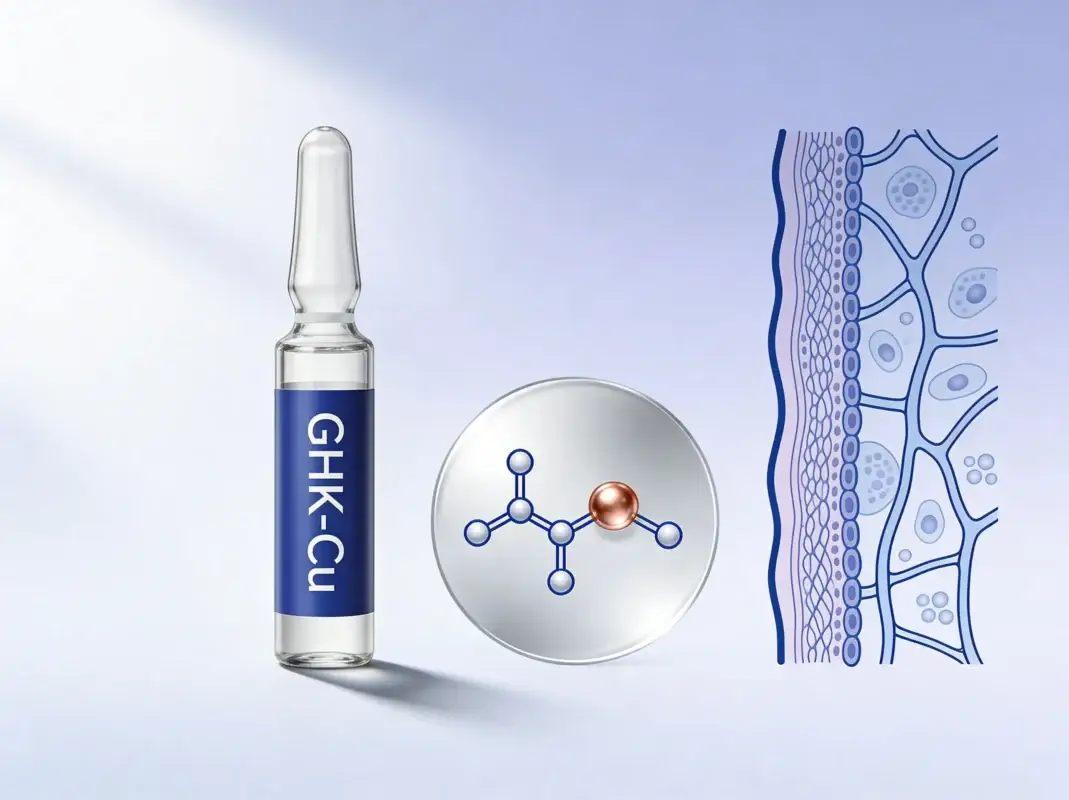
GHK-Cu is a naturally-occurring tripeptide complexed with a copper(II) ion. The peptide sequence is Glycyl-L-Histidyl-L-Lysine (Gly-His-Lys, abbreviated GHK), with a single Cu²⁺ ion bound primarily to the imidazole ring of the central histidine residue. The molecular weight of the GHK tripeptide alone is approximately 340 g/mol; the copper-complexed form has a molecular weight of approximately 403 g/mol when accounting for the copper ion and associated anions.
The compound was first identified by Pickart and colleagues in 1973 as a tripeptide present in human plasma that declined with age — from approximately 200 ng/mL in plasma of healthy 20-year-old subjects to approximately 80 ng/mL in healthy 60-year-old subjects [Ref. 1]. This age-related decline in circulating GHK-Cu has shaped much of the compound’s subsequent research positioning in regenerative and dermal research.
A structural and functional point worth emphasizing: the copper ion is essential to the compound’s activity profile. Uncomplexed GHK (without copper) has different research properties and is generally less active in the same models where GHK-Cu produces effects. The copper complexation enables specific interactions with enzymatic systems involved in collagen and elastin metabolism, and the copper ion itself contributes to certain antioxidant and enzymatic effects independent of the peptide carrier.
GHK-Cu is not approved by FDA, Health Canada, EMA, or any other regulatory agency for human therapeutic use. The compound is sold as a research peptide for laboratory research only. It also appears in some over-the-counter cosmetic products in skincare contexts, but the cosmetic-grade product and research-grade material are distinct supply chains with different quality standards.
Mechanism of Action
GHK-Cu’s mechanism is multi-faceted, with several converging pathways contributing to the compound’s observed effects in research models.
Fibroblast modulation and collagen synthesis. The longest-established mechanism in GHK-Cu research is direct modulation of dermal fibroblast behavior. Foundational research by Maquart, Borel, and colleagues in the 1980s documented GHK-Cu effects on fibroblast proliferation, collagen synthesis, and extracellular matrix remodeling in dermal research models [Ref. 3]. The compound promotes upregulation of collagen and elastin synthesis while modulating expression of matrix metalloproteinases involved in matrix remodeling.
Broad gene expression effects. Modern research using transcriptomic methods has documented GHK-Cu effects on hundreds of genes across pathways including wound healing, DNA repair, antioxidant defense, and anti-inflammatory signaling. The 2012 Pickart and Margolina review synthesized these findings and proposed GHK-Cu as a “broad-spectrum gene modulator” rather than a single-pathway compound [Ref. 2]. This gene expression breadth is what distinguishes GHK-Cu from more pathway-specific peptides in the broader research class.
Copper-mediated enzymatic effects. Copper is an essential cofactor for several enzymes involved in connective tissue metabolism, including lysyl oxidase (which crosslinks collagen and elastin) and superoxide dismutase (an important antioxidant enzyme). The copper ion delivered as GHK-Cu can participate in these enzymatic systems in ways that contribute to the compound’s overall research profile.
Anti-inflammatory and antioxidant effects. Research has documented GHK-Cu effects on inflammatory markers and oxidative stress responses in various model systems. These effects appear to involve both direct copper-mediated antioxidant activity and gene-expression-mediated modulation of inflammatory pathways.
Skin barrier and photoaging research. Clinical and preclinical research has examined GHK-Cu effects on skin barrier function, photoaging endpoints (including wrinkle depth, skin elasticity, and pigmentation), and related dermatological measures [Ref. 4]. This research line connects the cellular fibroblast effects to higher-level dermal outcomes.
A 2018 review by Pickart, Vasquez-Soltero, and Margolina synthesized the broader GHK-Cu research literature across skin, wound healing, and regenerative medicine domains [Ref. 5].
Research Applications
GHK-Cu research clusters into several primary domains, all interconnected by the underlying fibroblast and gene expression mechanisms.
Skin and dermal research
The longest-established research application. Studies have examined GHK-Cu effects on dermal fibroblast function, collagen and elastin synthesis, skin barrier integrity, and photoaging endpoints. This research line has the deepest literature, spanning from the 1980s foundational work through modern clinical research on topical GHK-Cu in skin aging models.
Wound healing research
Animal model and in vitro research has documented GHK-Cu effects on wound closure kinetics, granulation tissue formation, and angiogenesis at wound sites. The mechanism overlaps with the skin/dermal research line — the same fibroblast and gene expression effects that drive dermal remodeling also drive wound healing dynamics.
Hair follicle and hair growth research
A specific line of research has examined GHK-Cu effects on hair follicle biology, including effects on follicle cycling, dermal papilla cell function, and outcomes in hair loss research models. This is mechanistically related to the broader dermal research but addresses a distinct tissue context.
Gene expression and regenerative medicine
The transcriptomic research line — documenting GHK-Cu effects across hundreds of genes — has positioned the compound for broader regenerative medicine research applications beyond skin and wound healing. Pickart and Margolina’s gene expression work has been influential in expanding the research framing from “skin peptide” to “broad-spectrum regenerative modulator” [Ref. 2].
Combination research with other healing peptides
Researchers studying tissue repair commonly examine GHK-Cu alongside other healing peptides including BPC-157 and TB-500. The mechanisms are distinct — GHK-Cu acts through fibroblast/gene expression effects; BPC-157 through angiogenesis and vascular effects; TB-500 through actin sequestration and cell migration. The mechanistic complementarity makes the compounds candidates for combination research, though formal published research on GHK-Cu + BPC-157 + TB-500 combinations is limited.
Across all research domains, GHK-Cu is intended for laboratory research only in the Kinetic Compounds context. The compound has not been evaluated by FDA, Health Canada, or any other regulatory agency for human therapeutic use.
Dosing & Reconstitution for Research
Researchers working with lyophilized GHK-Cu reconstitute the compound with bacteriostatic water before use. The basic reconstitution math follows the standard concentration-equals-mass-divided-by-volume principle covered in our reconstitution tutorial.
A 50 mg vial of GHK-Cu reconstituted with 5 mL of bacteriostatic water yields 10 mg/mL. A 100 mg vial in 5 mL yields 20 mg/mL. GHK-Cu is often supplied in larger vial sizes than other research peptides because the compound is typically used at higher mass doses in research protocols — the small molecular weight (~340 g/mol for GHK; ~403 g/mol for the copper complex) means molar concentrations are extremely high per mg compared to larger peptides.
A point specific to GHK-Cu: the reconstituted solution typically has a distinct color — pale blue to blue-green from the copper ion. This is normal and indicates the copper complex is intact. A colorless reconstituted solution may suggest copper dissociation or other quality issues, and the vial should be visually verified against this expectation.
GHK-Cu is used in both injectable research applications and topical research applications (in skin/dermal research models). The reconstitution math is the same regardless of route; the working concentration for topical preparations is often substantially higher than for injectable preparations, reflecting different research designs.
Researchers can verify their concentration math against our peptide reconstitution calculator, which handles the conversion automatically.
This article does not provide dosing guidance for any therapeutic purpose. GHK-Cu is not approved for human therapeutic use.
Storage & Handling
Lyophilized GHK-Cu is stable at room temperature during shipping but should be moved to long-term storage at -20°C (-4°F), protected from light, on receipt. Under proper lyophilized conditions, the compound remains stable for 24 months or longer.
Once reconstituted, GHK-Cu should be stored at 2–8°C and used within 28 days. The copper complex is generally stable in solution at refrigerated temperatures, though prolonged exposure to light or oxidative conditions can affect the copper oxidation state. Repeated freeze-thaw cycles degrade peptide integrity and should be avoided.
Researchers planning to draw from a reconstituted vial across multiple sessions should consider aliquoting into smaller volumes immediately after reconstitution to minimize freeze-thaw exposure of the working stock.
Every vial should be visually inspected before use. The reconstituted solution should be clear and have a characteristic pale blue to blue-green color from the copper ion. Cloudiness, color loss (suggesting copper dissociation), discoloration to brown or other unusual colors (suggesting oxidation), or visible sediment indicates degradation, and the vial should not be used in research.
For full handling protocols across the broader peptide catalog, see our storage and reconstitution guide.
Sourcing Verified GHK-Cu for Research
GHK-Cu sourcing has some unique considerations beyond standard research peptide quality. Because the copper complexation is essential to the compound’s activity, sourcing verification must confirm both the peptide identity and the copper complex integrity.
A credible Certificate of Analysis for GHK-Cu should show HPLC purity for the peptide component, mass spectrometry confirmation matching the expected molecular weight (~403 Da for the copper complex), and ideally confirmation of copper content separate from peptide content. Uncomplexed GHK without copper has different research properties — a product labeled “GHK-Cu” that actually contains uncomplexed GHK is functionally a different compound. The principles of reading a research peptide COA are covered in detail in our reading a Certificate of Analysis article.
Kinetic Compounds tests every batch of GHK-Cu through Janoshik Analytical, an independent third-party laboratory. Current batch reports are published on the GHK-Cu product page. Our broader testing methodology is documented on our lab testing and COA page.
For researchers working across the broader healing peptide research class, BPC-157 and TB-500 are the most studied complementary compounds. The BPC-157 vs TB-500 comparison and the BPC-157 + TB-500 combination protocol articles cover related healing peptide research. The full healing & recovery research peptide catalog lists all related compounds.
Researching healing and regenerative peptides? Our complete healing & recovery research peptide catalog covers GHK-Cu, BPC-157, TB-500, KPV, and related compounds — all independently lab-tested with current Certificates of Analysis available on each product page.
Available for Research
Research Tools
Quality Promise
very batch independently tested by Janoshik Analytical. 98% purity minimum.
Frequently Asked Questions
What is GHK-Cu?
<p>GHK-Cu is a naturally-occurring tripeptide (Glycyl-Histidyl-Lysine) complexed with a copper(II) ion. The compound was first identified in human plasma in 1973 and has been studied across five decades for effects on skin, wound healing, and broader regenerative medicine through fibroblast modulation and gene expression mechanisms.</p>
Why is the copper ion important?
<p>The copper complexation is structurally and functionally essential to the compound's activity. Uncomplexed GHK without copper has substantially different research properties and is generally less active in the same models where GHK-Cu produces effects. The copper enables specific interactions with enzymatic systems involved in connective tissue metabolism, and contributes to certain antioxidant and enzymatic effects independent of the peptide carrier.</p>
Is GHK-Cu approved as a medication?
<p>No. GHK-Cu has not been approved by FDA, Health Canada, EMA, or any other regulatory agency for human therapeutic use. The compound appears in some over-the-counter cosmetic products in skincare contexts, but the cosmetic-grade product and research-grade material are distinct supply chains with different quality standards. Research-grade GHK-Cu sold by Kinetic Compounds is intended for laboratory research only.</p>
How is GHK-Cu different from BPC-157 and TB-500?
<p>The three compounds operate through entirely different mechanisms despite being studied in similar healing/repair research domains. GHK-Cu acts through fibroblast modulation, gene expression effects, and copper-mediated enzymatic activity. BPC-157 acts through angiogenesis and granulation tissue formation. TB-500 acts through G-actin sequestration and cell migration effects. The mechanistic complementarity is one reason researchers commonly study the compounds together in combination protocols.</p>
Why does the reconstituted GHK-Cu solution have a blue color?
<p>The pale blue to blue-green color comes from the copper(II) ion bound to the peptide. The color is normal and confirms the copper complex is intact. A colorless reconstituted solution may suggest copper dissociation, and the vial should be visually verified against this expectation. Brown or unusual coloration suggests oxidation or degradation and indicates the vial should not be used.</p>
Is research-grade GHK-Cu legal in Canada?
<p>Research-grade GHK-Cu is legal to purchase and possess in Canada for laboratory research purposes only. The compound is not approved by Health Canada for human therapeutic use.</p>
Where can I find a Certificate of Analysis for GHK-Cu?
<p>Kinetic Compounds publishes batch-specific Certificates of Analysis from Janoshik Analytical on the GHK-Cu product page. The COA should specify both the peptide component analysis and copper content. COAs can also be requested directly via research@kineticcompounds.com.</p>
References
- "The human tri-peptide GHK and tissue remodeling." Journal of Biomaterials Science. Polymer Edition, 19(8):969-988. — Pickart L (2008).
- "GHK and DNA: resetting the human genome to health." BioMed Research International, 2014:151479. — Pickart L, Vasquez-Soltero JM, Margolina A (2014).
- "Stimulation of collagen synthesis in fibroblast cultures by the tripeptide-copper complex glycyl-L-histidyl-L-lysine-Cu²⁺." FEBS Letters, 238(2):343-346. — Maquart FX, Pickart L, Laurent M, Gillery P, Monboisse JC, Borel JP (1988).
- "Effects of topical copper tripeptide complex on CO₂ laser-resurfaced skin." Archives of Facial Plastic Surgery, 8(4):252-259. — Miller TR, Wagner JD, Baack BR, Eisbach KJ (2006).
- "Regenerative and Protective Actions of the GHK-Cu Peptide in the Light of the New Gene Data." International Journal of Molecular Sciences, 19(7):1987. — Pickart L, Margolina A (2018).
Continue Reading
For Research Use Only Products described on this site are intended for laboratory research purposes only. They are not approved by Health Canada for human consumption, diagnosis, treatment, or prevention of any medical condition.