
Home / Research Articles / CJC-1295 + Ipamorelin: A Combination Protocol Research Guide
CJC-1295 + Ipamorelin: A Combination Protocol Research Guide
Key Takeaways
- The CJC-1295 + Ipamorelin combination is one of the most-studied dual-pathway approaches to growth hormone research, with each compound activating a distinct upstream receptor that converges on GH rel
- CJC-1295 acts on the GHRH receptor (the primary GH-stimulating receptor); Ipamorelin acts on the ghrelin receptor (GHS-R1a, a parallel upstream pathway). Combining the two produces a larger GH respons
- Protocol design considerations include the choice between CJC-1295 with DAC (sustained) versus without DAC (pulsatile), administration timing relative to circadian GH pulses, and whether to reconstitu
- The combination is intended exclusively for laboratory research — neither compound is approved for human therapeutic use, and combination protocols have not been evaluated by any regulatory agency.
- Independent third-party testing with Certificates of Analysis specifying each compound's identity and purity is essential before any combination protocol research.
The CJC-1295 + Ipamorelin combination is the most-discussed peptide stack in growth hormone research, and the reason is straightforward pharmacology: the two compounds activate entirely different upstream receptors, both of which converge on growth hormone release at the pituitary. When researchers want to study amplified GH responses without confounding cortisol or prolactin effects, this is the combination the published literature points toward.
This article addresses the CJC-1295 + Ipamorelin combination as a research framework — covering the mechanistic rationale, the structural protocol considerations researchers commonly factor in, the reconstitution and storage considerations specific to dual-compound research, and the sourcing standards that apply when running protocols with two distinct peptides simultaneously. The article does not provide therapeutic dosing guidance; both compounds are intended exclusively for laboratory research.
Why This Combination Works Mechanistically
The mechanistic rationale for combining CJC-1295 and Ipamorelin rests on a fundamental observation in growth hormone pharmacology: the somatotroph cells in the anterior pituitary integrate signals from two independent upstream receptors before releasing growth hormone, and activating both receptors simultaneously produces a larger response than activating either receptor alone.
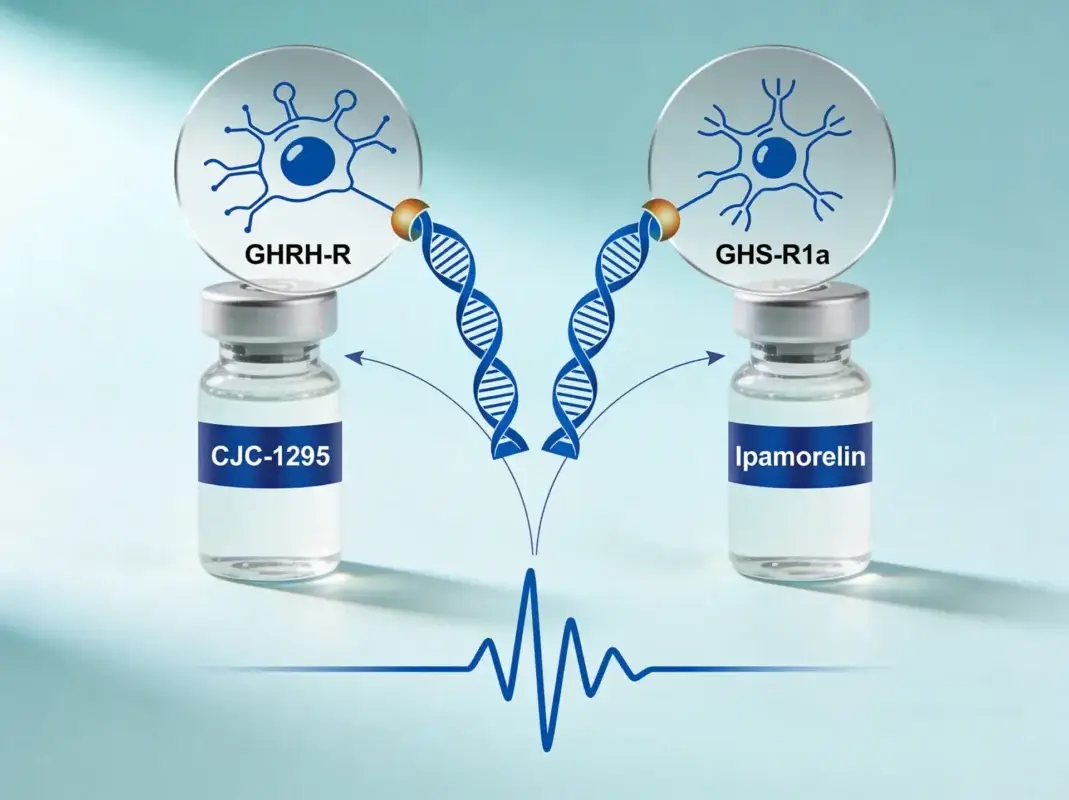
CJC-1295 is a synthetic analog of growth hormone-releasing hormone (GHRH). It binds the GHRH receptor (GHRH-R), the primary stimulus for GH release under physiological conditions. The GHRH-R pathway uses cAMP-mediated signaling and is the upstream signal most directly responsible for the pulsatile pattern of GH secretion [Ref. 3].
Ipamorelin is a synthetic pentapeptide that binds the growth hormone secretagogue receptor type 1a (GHS-R1a) — the ghrelin receptor. This is a separate G-protein-coupled receptor activated by ghrelin under physiological conditions, with downstream signaling that uses a different intracellular cascade than GHRH-R [Ref. 2].
The two receptors converge at the somatotroph: GHRH-R activation stimulates GH synthesis and release through one pathway; GHS-R1a activation does the same through a separate pathway; and when both are activated simultaneously, the responses combine and produce GH release substantially larger than either alone. The phenomenon was originally characterized by Cyril Bowers and colleagues, who established the synergistic GH release between GHRH and ghrelin-receptor agonists across multiple research models [Ref. 1].
The Ipamorelin selectivity also matters here. Unlike earlier GHRPs (GHRP-2, GHRP-6, hexarelin) that activate GHS-R1a but also elevate cortisol, prolactin, and aldosterone, Ipamorelin produces GH release with minimal off-target hormonal effects [Ref. 2]. In a combination protocol, this means the GH amplification from adding a ghrelin receptor agonist can be studied without simultaneously introducing cortisol or prolactin elevation as confounding variables.
A 2018 review by Sigalos and Pastuszak synthesizes the broader literature on this class of dual-pathway research [Ref. 4].
Structural Protocol Considerations
Research protocols using the CJC-1295 + Ipamorelin combination face several structural design choices that shape the kind of data the protocol will generate. This section describes those choices — it is not a dosing recommendation.
Choice of CJC-1295 variant
The first protocol design decision is which CJC-1295 variant to use, and the choice has substantial pharmacokinetic consequences. CJC-1295 with DAC has a half-life of approximately 6–8 days and produces sustained GH/IGF-1 elevation; CJC-1295 without DAC (also called Mod GRF 1-29) has a half-life of approximately 30 minutes and produces pulsatile GH release.
Research protocols designed to study acute, pulsatile GH responses generally use CJC-1295 without DAC paired with Ipamorelin (which itself has a ~2-hour half-life). This produces a sharp GH pulse from both upstream pathways that resolves within hours — closely mimicking the natural pulsatile pattern of physiological GH release.
Research protocols designed to study sustained GH/IGF-1 elevation generally use CJC-1295 with DAC paired with Ipamorelin, with the DAC variant providing the sustained baseline GHRH-receptor activation and Ipamorelin providing acute ghrelin-receptor pulses on top.
The two protocol designs answer different research questions. Neither is “better” in the abstract — the question dictates the variant.
Administration timing
GH secretion is naturally pulsatile, with the largest endogenous GH pulses occurring during slow-wave sleep [Ref. 5]. Research protocols frequently administer the compound combination shortly before periods of low expected endogenous GH activity, which minimizes interference from the natural pulse pattern. Some protocols use multiple administrations per session (in studies using the without-DAC CJC-1295 variant); others use single weekly administrations (in studies using the with-DAC variant).
The timing relative to food intake also matters in research designs that measure GH release dynamics, since insulin and free fatty acid levels modulate GH responsiveness. Many published protocols specify fasted-state administration for this reason.
Co-administration vs sequential
The two compounds can be administered together (one injection containing both reconstituted peptides) or separately (two distinct administrations within a short window). Co-administration is operationally simpler; separate administration preserves the ability to verify each compound’s identity and concentration independently and provides flexibility if dose adjustments are needed across the protocol.
Most published research protocols administer the two compounds separately, with reconstitution maintained in separate vials. Researchers running combination protocols at scale often standardize on this approach for the verification benefit.
Frequency
Frequency of administration depends on the variant choice. Protocols using CJC-1295 without DAC + Ipamorelin typically administer the combination on a daily schedule (sometimes multiple times daily) to study repeated pulse responses. Protocols using CJC-1295 with DAC + Ipamorelin typically administer the CJC-1295 with DAC once weekly and the Ipamorelin daily, since the sustained CJC-1295 with DAC effect spans the full week between doses.
Reconstitution and Storage for Dual-Peptide Protocols
Working with two peptides simultaneously introduces a few considerations beyond single-compound work.
Each compound is reconstituted with bacteriostatic water following standard technique — inject the bacteriostatic water down the inner wall of the vial, then swirl gently until dissolved. The mass-to-volume math for each compound is calculated independently using its own molecular weight: ~3,367 g/mol for CJC-1295 without DAC, ~3,647 g/mol for CJC-1295 with DAC, and ~712 g/mol for Ipamorelin. The dramatic molecular weight difference means molar concentrations differ substantially between the two compounds at the same mg/mL concentration.
Storage requirements are similar for both compounds: lyophilized vials at -20°C protected from light for long-term storage; reconstituted vials at 2–8°C and used within 28 days. Repeated freeze-thaw cycles should be avoided for both peptides.
Researchers can verify their concentration math for either compound against our peptide reconstitution calculator, which handles both peptide molecular weights automatically.
For full handling protocols across the broader peptide catalog, see our storage and reconstitution guide.
What Combination Protocols Are Studied For
The CJC-1295 + Ipamorelin combination appears in research across several primary domains.
Growth hormone and IGF-1 axis research. This is the core application — studying amplified GH release dynamics, IGF-1 production, and somatotroph cell responses across the dual-pathway stimulation. The combination is particularly useful where larger GH signals are needed than either compound produces alone.
Body composition research. Studies in animal models have examined effects on lean mass, fat mass, and metabolic parameters under combination protocol conditions. The chronic GH/IGF-1 elevation produced by sustained combination protocols has been particularly investigated for body composition endpoints.
Bone parameter research. Both compounds independently have research literature on bone-related endpoints (Ipamorelin has documented effects on bone formation in animal models; CJC-1295 contributes to the bone effects via downstream GH/IGF-1). Combination protocols extend this work to dual-pathway stimulation of bone-formation-related parameters.
Sleep and GH pulse architecture research. Because physiological GH release is tightly linked to slow-wave sleep, combination protocols are sometimes used in research models examining the relationship between GH pulse amplitude and sleep architecture.
Comparative pharmacology research. Combination protocols allow direct comparison of GHRH-pathway vs ghrelin-receptor-pathway contributions to GH release, when the protocol design includes single-compound control arms.
Across all research domains, the CJC-1295 + Ipamorelin combination is intended for laboratory research only. Neither compound is approved for human therapeutic use by any regulatory agency, and combination protocols have not been evaluated for therapeutic use under any framework.
Sourcing Standards for Combination Protocols
Combination protocol research depends on knowing exactly what is in each vial. The sourcing standards are not different from single-compound work, but the verification burden compounds — researchers need a credible Certificate of Analysis for each peptide separately, and both COAs need to specify the exact variant where multiple variants exist (particularly relevant for CJC-1295, where with-DAC and without-DAC variants are commonly confused).
A credible Certificate of Analysis for either compound should show HPLC purity expressed as a percentage, mass spectrometry confirmation matching the expected molecular weight for the specific compound and variant, and a clear distinction between peptide content and peptide mass. The principles of reading a research peptide COA are covered in detail in our reading a Certificate of Analysis article.
Kinetic Compounds tests every batch of every GH peptide product through Janoshik Analytical, an independent third-party laboratory. Current batch reports are published directly on each product page: CJC-1295 (with DAC), CJC-1295 no DAC, and Ipamorelin. Our broader testing methodology is documented on our lab testing and COA page, and the full growth hormone research peptide catalog lists all related compounds including Tesamorelin, which can substitute for CJC-1295 in some research designs.
Sourcing peptides for combination protocol research? Our complete growth hormone research peptide catalog covers CJC-1295 (both variants), Ipamorelin, Tesamorelin, and related compounds — all independently lab-tested with current Certificates of Analysis available on each product page.
Related Peptides
Related peptides will load here via PHP snippet.
Available for Research
Research Tools
Quality Promise
very batch independently tested by Janoshik Analytical. 98% purity minimum.
Frequently Asked Questions
Why are CJC-1295 and Ipamorelin commonly combined in research?
<p>The two compounds activate distinct upstream receptors that converge on growth hormone release at the pituitary. CJC-1295 acts on the GHRH receptor; Ipamorelin acts on the ghrelin receptor (GHS-R1a). Combining the two activates both pathways simultaneously and produces a larger GH response than either compound alone — a phenomenon originally characterized by Cyril Bowers and colleagues.</p>
Should I use CJC-1295 with or without DAC in a combination protocol?
<p>The choice depends on the research question. CJC-1295 without DAC (~30-minute half-life) is generally used in protocols studying pulsatile, acute GH responses. CJC-1295 with DAC (~6–8 day half-life) is generally used in protocols studying sustained GH/IGF-1 elevation. Both variants can be combined with Ipamorelin; the resulting protocols answer different questions.</p>
Can the two compounds be reconstituted together in one vial?
<p>Most published research protocols reconstitute the two compounds in separate vials, even when they are administered together. Separate reconstitution preserves the ability to verify each compound's identity and concentration independently and provides flexibility for dose adjustments. Combining them pre-reconstitution is operationally simpler but loses these benefits.</p>
Are combination protocols approved for any therapeutic use?
<p>No. Neither CJC-1295 nor Ipamorelin is approved for human therapeutic use by any regulatory agency, individually or in combination. CJC-1295 + Ipamorelin combination protocols have not been evaluated under any regulatory framework. The combination is intended exclusively for laboratory research.</p>
What's the difference between this combination and Tesamorelin alone?
<p>Tesamorelin is the only approved GHRH analog (FDA-approved as Egrifta, Health Canada-approved as Egrifta SV, both for HIV-associated lipodystrophy). Used alone, Tesamorelin activates only the GHRH receptor pathway. The CJC-1295 + Ipamorelin combination activates both the GHRH pathway and the ghrelin receptor pathway, producing dual-pathway stimulation that Tesamorelin alone does not provide.</p>
How is concentration math handled across two different peptides?
<p>Each compound's concentration is calculated independently using its own molecular weight. CJC-1295 (~3,367 or ~3,647 g/mol depending on variant) and Ipamorelin (~712 g/mol) have substantially different molecular weights, so molar concentrations differ even at the same mg/mL. Our reconstitution calculator handles both.</p>
Where can I find Certificates of Analysis for both compounds?
<p>Kinetic Compounds publishes batch-specific Certificates of Analysis from Janoshik Analytical on the product pages for both compounds (and both CJC-1295 variants). COAs can also be requested directly via research@kineticcompounds.com.</p>
References
- "Sustained elevation of pulsatile growth hormone (GH) secretion and insulin-like growth factor I (IGF-I), IGF-binding protein-3 (IGFBP-3), and IGFBP-5 concentrations during 30-day continuous subcutaneous infusion of GH-releasing peptide-2 in older men and women." Journal of Clinical Endocrinology an
- "Ipamorelin, the first selective growth hormone secretagogue." European Journal of Endocrinology, 139(5):552-561. — Raun K, Hansen BS, Johansen NL, Thøgersen H, Madsen K, Ankersen M, Andersen PH (1998).
- "Prolonged stimulation of growth hormone (GH) and insulin-like growth factor I secretion by CJC-1295, a long-acting analog of GH-releasing hormone, in healthy adults." Journal of Clinical Endocrinology and Metabolism, 91(3):799-805. — Teichman SL, Neale A, Lawrence B, Gagnon C, Castaigne JP, Frohman
- "The Safety and Efficacy of Growth Hormone Secretagogues." Sexual Medicine Reviews, 6(1):45-53. — Sigalos JT, Pastuszak AW (2018).
- "Neurophysiological regulation and target-tissue impact of pulsatile growth hormone secretion in the human." Growth Hormone & IGF Research, 11 Suppl A:S25-37. — Veldhuis JD, Bowers CY (2001).
Continue Reading
For Research Use Only Products described on this site are intended for laboratory research purposes only. They are not approved by Health Canada for human consumption, diagnosis, treatment, or prevention of any medical condition.