
Home / Research Articles / Tesamorelin: The Approved GHRH Analog — Mechanism, Research, and Sourcing
Tesamorelin: The Approved GHRH Analog — Mechanism, Research, and Sourcing
Key Takeaways
- Tesamorelin is a synthetic 44-amino-acid analog of growth hormone-releasing hormone (GHRH) with a single N-terminal trans-3-hexenoyl modification that protects against enzymatic degradation.
- The compound is the only GHRH analog approved by the FDA (Egrifta, 2010) and Health Canada (Egrifta SV), with the approved indication being HIV-associated lipodystrophy.
- Beyond the approved indication, Tesamorelin has an expanding research base in non-alcoholic fatty liver disease (NAFLD/MASLD), visceral adiposity, and metabolic syndrome research.
- Tesamorelin produces sustained GH and IGF-1 elevation with daily dosing and a short circulating half-life (~26–38 minutes), preserving the natural pulsatile pattern of GH release.
- Research-grade Tesamorelin is intended exclusively for laboratory research and is distinct from the approved pharmaceutical products Egrifta and Egrifta SV.fd
Tesamorelin occupies a unique position in the growth hormone peptide research class: it is the only synthetic GHRH analog that has received regulatory approval for human therapeutic use. The compound was approved by the FDA in 2010 under the brand name Egrifta and by Health Canada under the brand name Egrifta SV, with the approved indication being HIV-associated lipodystrophy — a metabolic complication of long-term antiretroviral therapy. That regulatory status gives Tesamorelin a substantially deeper research base than other GHRH analogs in this category, including clinical trial data spanning more than fifteen years and emerging research in non-alcoholic fatty liver disease, metabolic syndrome, and related conditions.
This article addresses Tesamorelin as a research compound, covering its structural origins, the GHRH receptor mechanism it shares with CJC-1295 and other analogs, the research applications where its substantial clinical literature is most relevant, and the careful distinction between research-grade Tesamorelin and the approved pharmaceutical products Egrifta and Egrifta SV.
What Is Tesamorelin?
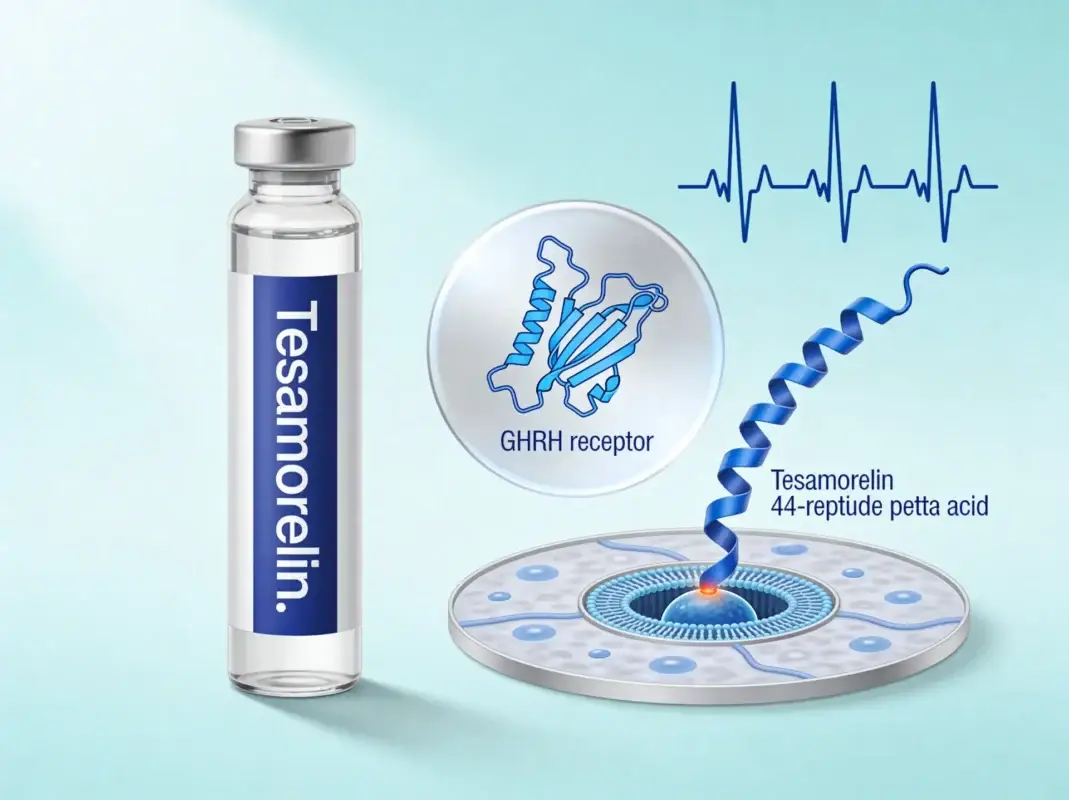
Tesamorelin is a synthetic 44-amino-acid analog of human growth hormone-releasing hormone (GHRH). Native GHRH is a 44-amino-acid hypothalamic peptide that stimulates growth hormone release from the anterior pituitary; Tesamorelin shares the full 44-residue sequence with native GHRH but adds a single structural modification — a trans-3-hexenoyl (a six-carbon fatty acid) group covalently attached to the N-terminal tyrosine residue. The molecular weight is approximately 5,196 g/mol, and the CAS registry number is 901758-09-6.
The single N-terminal modification is the structural feature that distinguishes Tesamorelin from native GHRH and from other GHRH analogs in the same class. The hexenoyl group blocks recognition by dipeptidyl peptidase-4 (DPP-4), the enzyme that rapidly degrades native GHRH in circulation. This modification extends Tesamorelin’s circulating half-life to approximately 26–38 minutes — substantially longer than native GHRH’s two minutes, though still shorter than the modified GRF 1-29 backbone variants such as CJC-1295.
Tesamorelin was developed by Theratechnologies and received FDA approval in 2010 for the treatment of excess abdominal fat in HIV-infected patients with lipodystrophy. Health Canada approved the same compound (under the brand name Egrifta SV) for the same indication. Research-grade Tesamorelin sold for laboratory research is intended exclusively for that purpose — it is not equivalent to the approved pharmaceutical products and is not a substitute for them in any clinical context.
Mechanism of Action
Tesamorelin acts through agonism of the growth hormone-releasing hormone receptor (GHRH-R), the same G-protein-coupled receptor activated by native GHRH and by CJC-1295. Receptor activation triggers a cAMP-mediated cascade that stimulates the synthesis and pulsatile secretion of growth hormone (GH) from somatotroph cells in the anterior pituitary.
The downstream effects of GHRH receptor activation are well-characterized.
Growth hormone secretion. GHRH agonism is the primary upstream signal for GH release. Tesamorelin’s short half-life means each daily dose produces a sustained but time-limited GH stimulus that resolves before the next dose, preserving the natural pulsatile pattern of GH secretion.
IGF-1 production. Sustained increases in circulating GH stimulate hepatic production of insulin-like growth factor 1 (IGF-1), which mediates many of GH’s downstream effects on body composition, hepatic metabolism, and tissue growth.
Feedback regulation. GH and IGF-1 feed back on the hypothalamus and pituitary, partly through stimulation of somatostatin. This negative feedback loop is the reason GH secretion is pulsatile under physiological conditions, and Tesamorelin’s pharmacokinetic profile is well-matched to this physiology [Ref. 5].
The contrast with CJC-1295 with DAC is instructive. Both compounds activate the same receptor, but Tesamorelin’s short half-life produces a daily GH pulse that resolves, while CJC-1295 with DAC produces sustained receptor activation over six to eight days. The Tesamorelin profile preserves pulsatility; the CJC-1295 with DAC profile alters it. A 2018 review by Sigalos and Pastuszak synthesizes the broader literature on synthetic GHRH analogs and growth hormone-releasing peptides in this research class [Ref. 4].
Research Applications
Tesamorelin’s regulatory approval has produced the deepest clinical research base of any GHRH analog. Research applications cluster into several primary domains.
HIV-associated lipodystrophy
This is the approved indication, established by the Falutz and colleagues phase 3 trial published in the New England Journal of Medicine in 2007 [Ref. 1]. The trial demonstrated significant reductions in visceral adipose tissue in HIV-positive patients with lipodystrophy receiving Tesamorelin compared with placebo. Subsequent extension trials and post-approval research have reinforced the visceral fat reduction effect and characterized the IGF-1 response over longer dosing periods.
Non-alcoholic fatty liver disease (NAFLD / MASLD)
The most active area of recent Tesamorelin research is liver fat. Stanley and colleagues published a randomized clinical trial in JAMA in 2014 demonstrating that Tesamorelin reduced both visceral fat and liver fat in HIV-positive patients with abdominal fat accumulation [Ref. 2]. A 2019 trial in Annals of Internal Medicine extended these findings, specifically examining Tesamorelin’s effects on NAFLD in HIV-positive patients and showing reductions in hepatic steatosis [Ref. 3].
This research has positioned Tesamorelin alongside Retatrutide as one of the few peptide compounds with documented effects on liver fat, though through entirely different mechanisms. Retatrutide reduces liver fat through direct glucagon receptor activation; Tesamorelin reduces liver fat indirectly through GH-mediated effects on hepatic lipid metabolism.
Metabolic syndrome and visceral adiposity research
Beyond the HIV context, Tesamorelin has been investigated in broader metabolic syndrome research focused on visceral adiposity and its metabolic sequelae. The mechanism — GH-mediated reduction in visceral fat depots — is mechanistically relevant beyond the HIV population, though most published research remains in the HIV/lipodystrophy context.
Cognitive function research
A smaller but notable line of Tesamorelin research has examined cognitive endpoints in older adults, building on the broader literature linking GH/IGF-1 signaling to cognitive function. This research is less established than the lipodystrophy or NAFLD work but represents an emerging domain.
Comparison with other GHRH-axis compounds
Researchers comparing GH-axis approaches frequently consider Tesamorelin alongside CJC-1295 (same receptor, different pharmacokinetic profile) and Ipamorelin (different receptor, complementary upstream pathway). The three compounds together cover the major upstream approaches to GH stimulation studied in current peptide research.
Across all research domains, research-grade Tesamorelin is intended for laboratory research only. The compound has not been evaluated as research-grade material by any regulatory agency, and the approved pharmaceutical products (Egrifta, Egrifta SV) are not substitutes for research-grade material in laboratory contexts.
Research-Grade Tesamorelin vs Approved Pharmaceutical Products
The distinction between research-grade Tesamorelin and the approved products Egrifta and Egrifta SV deserves explicit treatment. The two are not interchangeable, and the distinction matters for researchers, clinicians, and anyone else encountering Tesamorelin in different contexts.
Egrifta and Egrifta SV are pharmaceutical-grade Tesamorelin formulated and approved for human therapeutic use in HIV-associated lipodystrophy. These products carry full regulatory documentation, prescriber-only access, defined manufacturing standards under cGMP, sterile injectable formulation, and approved labeling for the specific patient population. Patients with HIV-associated lipodystrophy receive these products through prescription channels, not from research peptide suppliers.
Research-grade Tesamorelin is the same active peptide produced for laboratory research purposes. It is not formulated, labeled, or sold as a substitute for the approved pharmaceutical products. Research-grade material may be used in animal model research, in vitro studies, and other laboratory applications, but is not intended for human therapeutic use under any circumstances.
This distinction parallels the pattern with other approved peptides studied as research compounds. Researchers should source through clearly research-focused channels with third-party Certificates of Analysis; patients should obtain Egrifta or Egrifta SV through pharmaceutical channels.
Dosing & Reconstitution for Research
Researchers working with lyophilized Tesamorelin reconstitute the compound with bacteriostatic water before use. The basic reconstitution math follows the standard concentration-equals-mass-divided-by-volume principle.
A 5 mg vial of Tesamorelin reconstituted with 2 mL of bacteriostatic water yields 2.5 mg/mL. A 10 mg vial in 2 mL yields 5 mg/mL. Tesamorelin’s molecular weight of ~5,196 g/mol means molar concentrations are similar to those for CJC-1295 (~3,367–3,647 g/mol) but distinctly different from Ipamorelin (~712 g/mol). Researchers running comparison or combination protocols across these compounds should be careful with molar versus mass concentration math, since the molecular weights span an order of magnitude across the class.
Reconstitution technique is standard: inject bacteriostatic water down the inner wall of the vial rather than directly onto the lyophilized powder, then swirl gently until dissolved.
Researchers can verify their concentration math against our peptide reconstitution calculator, which handles the conversion automatically.
This article does not provide dosing guidance for any therapeutic purpose. Therapeutic dosing of Egrifta or Egrifta SV in HIV-associated lipodystrophy is determined by prescribing clinicians using the approved labeling. Research-grade Tesamorelin is intended for laboratory research only.
Storage & Handling
Lyophilized Tesamorelin is stable at room temperature during shipping but should be moved to long-term storage at -20°C (-4°F), protected from light, on receipt. Under proper lyophilized conditions, the compound remains stable for 24 months or longer.
Once reconstituted, Tesamorelin should be stored at 2–8°C and used within 28 days. The N-terminal fatty acid modification does not significantly change storage requirements compared to other GHRH analogs. Repeated freeze-thaw cycles degrade peptide integrity and should be avoided.
Researchers planning to draw from a reconstituted vial across multiple sessions should consider aliquoting into smaller volumes immediately after reconstitution to minimize freeze-thaw exposure of the working stock.
Every vial should be visually inspected before use. The reconstituted solution should be clear and free of particulates. Cloudiness, discoloration, or visible sediment indicates degradation, and the vial should not be used in research.
For full handling protocols across the broader peptide catalog, see our storage and reconstitution guide.
Sourcing Verified Tesamorelin for Research
Tesamorelin’s molecular weight of approximately 5,196 g/mol distinguishes it clearly from other GHRH analogs (CJC-1295 with DAC at ~3,647 g/mol, CJC-1295 without DAC at ~3,367 g/mol) and from ghrelin-class peptides (Ipamorelin at ~712 g/mol). Mass spectrometry verification is straightforward when properly performed — the molecular weight is distinctive enough that mislabeling within the broader GH peptide class is easily detected.
A credible Certificate of Analysis for research-grade Tesamorelin should show HPLC purity expressed as a percentage, mass spectrometry confirmation matching ~5,196 Da, and a clear distinction between peptide content and peptide mass. The Certificate should be batch-specific and reference the testing methodology used.
Kinetic Compounds tests every batch of Tesamorelin through Janoshik Analytical, an independent third-party laboratory. Current batch reports are published directly on the Tesamorelin product page. Our broader testing methodology is documented on our lab testing and COA page, and the analytical principles behind Certificates of Analysis are covered in our reading a Certificate of Analysis article.
For researchers running comparison protocols across GHRH-axis compounds, CJC-1295 (with DAC), CJC-1295 no DAC, and Ipamorelin are listed alongside Tesamorelin in our growth hormone research peptide catalog.
For prescription Tesamorelin intended for human therapeutic use in HIV-associated lipodystrophy, patients should obtain Egrifta or Egrifta SV through pharmaceutical channels. Research-grade Tesamorelin is not a substitute for these approved products.
Researching the GHRH-axis peptide class? Our complete growth hormone research peptide catalog covers Tesamorelin, CJC-1295, Ipamorelin, and related compounds — all independently lab-tested with current Certificates of Analysis available.
Related Peptides
Related peptides will load here via PHP snippet.
Available for Research
Research Tools
Quality Promise
very batch independently tested by Janoshik Analytical. 98% purity minimum.
Frequently Asked Questions
What is Tesamorelin?
<p>Tesamorelin is a synthetic 44-amino-acid analog of human growth hormone-releasing hormone (GHRH) with a single N-terminal fatty acid modification that protects against enzymatic degradation. The compound is approved by the FDA (as Egrifta) and Health Canada (as Egrifta SV) for HIV-associated lipodystrophy. Research-grade Tesamorelin is intended for laboratory research and is distinct from the approved pharmaceutical products.</p>
How is Tesamorelin different from CJC-1295?
<p>Tesamorelin and CJC-1295 both act on the GHRH receptor, but the two compounds differ structurally and pharmacokinetically. Tesamorelin is the full 44-amino-acid GHRH sequence with a single N-terminal modification; CJC-1295 is based on a 29-amino-acid modified fragment (modified GRF 1-29) with multiple internal substitutions, and the with-DAC variant adds an albumin-binding modification that extends half-life to 6–8 days. Tesamorelin's half-life is much shorter (26–38 minutes), preserving pulsatile GH secretion.</p>
Is Tesamorelin approved as a medication?
<p>Yes. Tesamorelin is approved by the FDA (brand name Egrifta) and by Health Canada (brand name Egrifta SV) for HIV-associated lipodystrophy. The approved pharmaceutical products are obtained through prescription channels and are distinct from research-grade Tesamorelin sold for laboratory research.</p>
What is the difference between Tesamorelin and Egrifta?
<p>Egrifta and Egrifta SV are the approved pharmaceutical product formulations of Tesamorelin manufactured to pharmaceutical standards and approved for human therapeutic use in HIV-associated lipodystrophy. Research-grade Tesamorelin is the same active peptide produced for laboratory research purposes — not formulated, labeled, or sold as a substitute for the approved products.</p>
What is Tesamorelin studied for besides HIV-associated lipodystrophy?
<p>Beyond the approved indication, Tesamorelin research focuses on non-alcoholic fatty liver disease (NAFLD/MASLD), visceral adiposity, metabolic syndrome, and cognitive function in aging. The NAFLD research is the most active recent area, with randomized trial data published in JAMA and Annals of Internal Medicine.</p>
How is Tesamorelin reconstituted for research?
<p>Lyophilized Tesamorelin is reconstituted with bacteriostatic water. A 5 mg vial in 2 mL yields 2.5 mg/mL. Standard peptide reconstitution technique applies — inject bacteriostatic water down the inner wall of the vial, swirl gently. Researchers can verify calculations using our reconstitution calculator.</p>
Is research-grade Tesamorelin legal in Canada?
<p>Research-grade Tesamorelin is legal to purchase and possess in Canada for laboratory research purposes only. The approved pharmaceutical product Egrifta SV is available by prescription for HIV-associated lipodystrophy.</p>
References
- "Metabolic effects of a growth hormone-releasing factor in patients with HIV." New England Journal of Medicine, 357(23):2359-2370. — Falutz J, Allas S, Blot K, et al. (2007).
- Ref. 2 — Stanley TL, Feldpausch MN, Oh J, Branch KL, Lee H, Torriani M, Grinspoon SK (2014). "Effect of tesamorelin on visceral fat and liver fat in HIV-infected patients with abdominal fat accumulation: a randomized clinical trial." JAMA, 312(4):380-389.
- "Effects of tesamorelin on non-alcoholic fatty liver disease in HIV: a randomised, double-blind, multicentre trial." The Lancet HIV, 6(12):e821-e830. — Stanley TL, Fourman LT, Feldpausch MN, et al. (2019).
- Ref. 4 — Sigalos JT, Pastuszak AW (2018). "The Safety and Efficacy of Growth Hormone Secretagogues." Sexual Medicine Reviews, 6(1):45-53.
- Ref. 5 — Veldhuis JD, Bowers CY (2001). "Neurophysiological regulation and target-tissue impact of pulsatile growth hormone secretion in the human." Growth Hormone & IGF Research, 11 Suppl A:S25-37.
Continue Reading
For Research Use Only Products described on this site are intended for laboratory research purposes only. They are not approved by Health Canada for human consumption, diagnosis, treatment, or prevention of any medical condition.