
Home / Research Articles / CJC-1295: Mechanism, Variants, and Research Applications
CJC-1295: Mechanism, Variants, and Research Applications
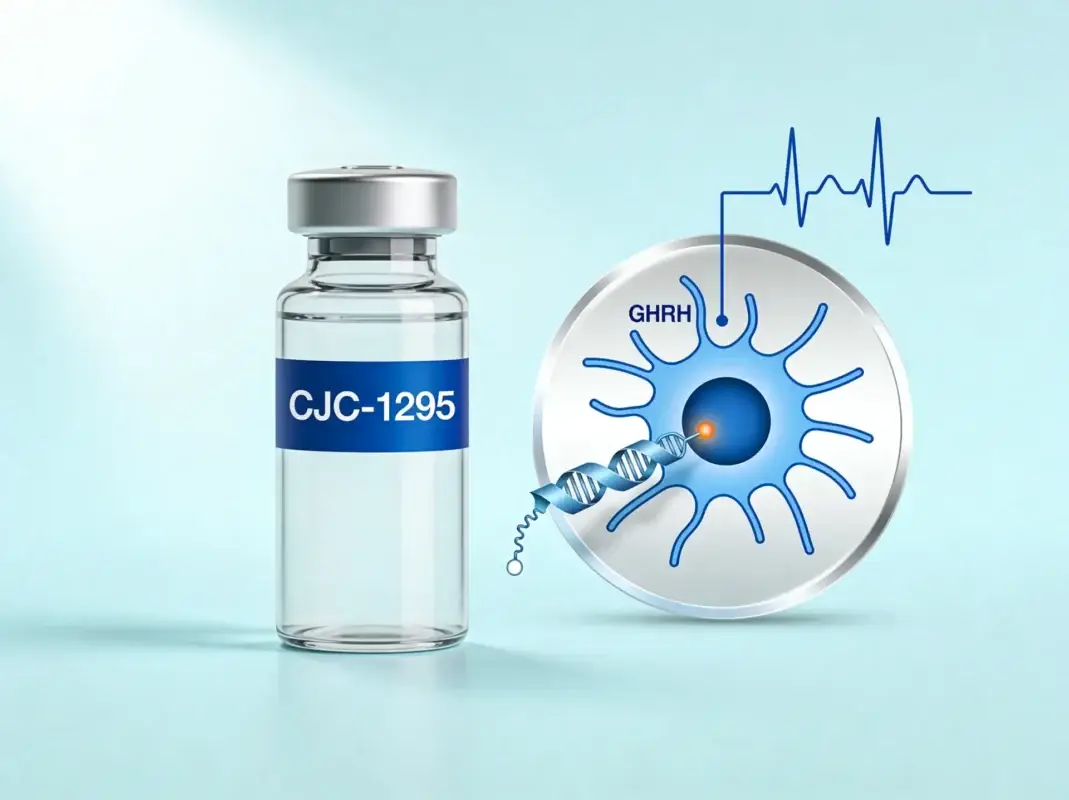
Key Takeaways
- CJC-1295 is a synthetic growth hormone-releasing hormone (GHRH) analog derived from the N-terminal active region of human GHRH with four stability-enhancing amino acid modifications.
- The compound exists in two research forms — with and without a Drug Affinity Complex (DAC) modification — that differ substantially in half-life (~6–8 days with DAC, ~30 minutes without DAC).
- Both variants act through GHRH receptor agonism, stimulating growth hormone release from the anterior pituitary and downstream IGF-1 production.
- Research applications include GH/IGF-1 axis studies, combination protocols with GH-releasing peptides such as Ipamorelin, and body composition research.
- CJC-1295 is not approved for human therapeutic use by any regulatory agency and is intended exclusively for laboratory research.
CJC-1295 is one of the most-studied synthetic growth hormone-releasing hormone (GHRH) analogs in research circles — and one of the most frequently misunderstood. The compound exists in two distinct forms with substantially different pharmacokinetic profiles, and researchers buying material labeled simply “CJC-1295” can find themselves working with either variant depending on the source. The form a research protocol calls for matters: it determines whether the compound produces sustained or pulsatile growth hormone release, and that distinction shapes the kind of research questions the compound can address.
This article addresses CJC-1295 as a research compound, covering both variants, the GHRH receptor mechanism they share, the research domains where each is most useful, and the sourcing considerations that come with a compound where mislabeling between variants is common.
What Is CJC-1295?
CJC-1295 is a synthetic peptide derived from the N-terminal active fragment of human growth hormone-releasing hormone (GHRH). Native GHRH is a 44-amino-acid hypothalamic peptide that stimulates growth hormone release from the anterior pituitary, with a circulating half-life of only minutes. The active region for GHRH receptor binding is the N-terminal 29 amino acids, often referred to as GRF 1-29.
CJC-1295 builds on the modified GRF 1-29 sequence with four amino acid substitutions that improve enzymatic stability: D-Ala at position 2 (protects against DPP-4 degradation), Gln at position 8, Ala at position 15, and Leu at position 27. These modifications were developed and originally characterized by ConjuChem in the early 2000s.
The compound exists in two research forms. The base modified GRF 1-29 sequence — sometimes labeled “CJC-1295 without DAC” or “Mod GRF 1-29” — is a 29-amino-acid peptide with a relatively short half-life of approximately 30 minutes. The DAC (Drug Affinity Complex) variant adds a maleimidopropionyl-lysine residue at the C-terminus, which forms a covalent bond with circulating serum albumin and extends the functional half-life dramatically — to approximately 6–8 days. These two variants are chemically distinct molecules with markedly different research profiles.
Neither variant is approved for human therapeutic use by any regulatory agency. CJC-1295 is intended exclusively for laboratory research.
Mechanism of Action
Both CJC-1295 variants act through the same primary mechanism: agonism of the growth hormone-releasing hormone receptor (GHRH-R), a G-protein-coupled receptor expressed primarily on somatotroph cells in the anterior pituitary. Receptor activation triggers a cAMP-mediated signaling cascade that stimulates the synthesis and pulsatile secretion of growth hormone (GH) from the pituitary into systemic circulation.
The downstream effects of GHRH receptor activation are well-characterized in the broader GH axis literature.
Growth hormone secretion. GHRH agonism is the primary upstream signal for GH release. Native GH pulses occur in characteristic bursts approximately every 3–4 hours under basal conditions, with the largest pulses typically during slow-wave sleep [Ref. 5].
IGF-1 production. Sustained increases in circulating GH stimulate hepatic production of insulin-like growth factor 1 (IGF-1), which mediates many of GH’s downstream effects on body composition and tissue growth.
Feedback regulation. GH and IGF-1 feed back on the hypothalamus and pituitary, partly through stimulation of somatostatin, which inhibits further GH release. This negative feedback loop is the reason GH secretion is pulsatile rather than continuous under physiological conditions.
The feedback dynamics are the most important mechanistic consideration for comparing the two CJC-1295 variants. The without-DAC form, with its short half-life, produces a sharp pulse of GH release followed by clearance — preserving the natural pulsatile pattern. The DAC form, with its much longer half-life, produces sustained elevation of GH and IGF-1 over days. A 2006 study by Ionescu and Frohman demonstrated that pulsatile GH secretion persists during continuous CJC-1295 stimulation, indicating that the underlying somatotroph pulsatility is preserved even when receptor activation is sustained [Ref. 2].
A 2018 review by Sigalos and Pastuszak synthesizes the broader literature on synthetic GHRH analogs and GH-releasing peptides [Ref. 3].
The Two Variants — With DAC and Without DAC
The two CJC-1295 variants share a sequence and a mechanism but differ in pharmacokinetics in ways that fundamentally change their research utility.
CJC-1295 without DAC (Mod GRF 1-29)
The base modified GRF 1-29 sequence has a half-life of approximately 30 minutes in circulation. This produces a sharp, transient pulse of GH release followed by clearance — closely mimicking the natural pulsatile pattern of GHRH-driven GH secretion. Research protocols using the without-DAC variant typically administer the compound at multiple time points to study pulsatile GH responses, sleep-architecture-correlated GH pulses, or acute GH/IGF-1 dynamics.
CJC-1295 with DAC
The DAC modification adds a reactive lysine residue at the C-terminus that forms a covalent bond with circulating serum albumin, dramatically extending the half-life to approximately 6–8 days. This produces sustained GH and IGF-1 elevation lasting roughly a week per dose. The Teichman 2006 study in the Journal of Clinical Endocrinology and Metabolism established the prolonged GH and IGF-1 stimulation profile of the DAC variant and remains the foundational citation for the compound [Ref. 1].
The trade-off is that the DAC variant’s sustained activity alters the natural pulsatile pattern of GH release, which some research designs consider undesirable. Research protocols using the DAC variant are typically designed around weekly dosing and aggregate GH/IGF-1 exposure rather than discrete pulse responses.
A detailed head-to-head comparison of the two variants — covering research outcomes, protocol design considerations, and practical selection criteria — is forthcoming in our research library.
Research Applications
CJC-1295 research clusters into several primary domains, with either variant used depending on the specific research question.
Growth hormone and IGF-1 axis research
This is the core research application — using CJC-1295 to manipulate the GH/IGF-1 axis in animal models and in vitro systems for studies of GH secretion dynamics, IGF-1 production, and downstream growth factor signaling. Both variants are used here, with the choice between them driven by whether the protocol calls for pulsatile or sustained elevation.
Combination studies with GH secretagogues
Research on synergistic GH release commonly combines CJC-1295 (a GHRH agonist, upstream stimulus) with a growth hormone-releasing peptide (GHRP) such as Ipamorelin, which acts on the ghrelin receptor — a separate upstream pathway converging on GH release. The two compound classes activate distinct mechanisms that converge at the pituitary, and combination protocols are commonly used to study amplified GH responses. A dedicated CJC-1295 + Ipamorelin protocol article is forthcoming.
Body composition research
Studies have examined effects on lean mass, fat mass, and metabolic parameters in animal models, with results that depend on which variant is used and the specific protocol design. The chronic GH/IGF-1 elevation produced by the DAC variant has been particularly studied for body composition outcomes.
Related GHRH analog research
The broader GHRH analog literature includes the only approved compound in this class, Tesamorelin, which received FDA approval for HIV-associated lipodystrophy based on clinical research published by Stanley and colleagues [Ref. 4]. Tesamorelin’s clinical research base provides useful mechanistic context for CJC-1295 research, since both compounds engage the same GHRH receptor.
Across all research domains, CJC-1295 is intended for laboratory research only. The compound has not been evaluated by any regulatory agency for human therapeutic use.
Dosing & Reconstitution for Research
Researchers working with lyophilized CJC-1295 reconstitute the compound with bacteriostatic water before use. The basic reconstitution math follows the standard concentration-equals-mass-divided-by-volume principle.
A 5 mg vial of CJC-1295 without DAC reconstituted with 2 mL of bacteriostatic water yields 2.5 mg/mL. A 2 mg vial of CJC-1295 with DAC reconstituted with 1 mL yields 2 mg/mL. The two variants are reconstituted identically — they differ in molecular weight only modestly (without DAC ~3,367 Da, with DAC ~3,647 Da), but the dosing math is calculated the same way.
Because of the dramatic half-life difference between variants, research protocols typically dose the two forms quite differently. The without-DAC variant is often administered multiple times per session in research designs that capture pulsatile GH responses. The DAC variant is administered weekly, and protocols are designed around steady-state GH/IGF-1 elevation rather than acute pulse responses.
Reconstitution technique is standard: inject bacteriostatic water down the inner wall of the vial rather than directly onto the lyophilized powder, then swirl gently until dissolved.
Researchers can verify their concentration math against our peptide reconstitution calculator, which handles the conversion automatically.
This article does not provide dosing guidance for any therapeutic purpose. CJC-1295 is not approved for human therapeutic use.
Storage & Handling
Lyophilized CJC-1295 is stable at room temperature for the duration of standard shipping but should be moved to long-term storage at -20°C (-4°F), protected from light, on receipt. Under proper lyophilized conditions, both variants remain stable for 24 months or longer.
Once reconstituted, CJC-1295 should be stored at 2–8°C and used within 28 days. The DAC variant’s modified C-terminus does not significantly change storage requirements compared to the without-DAC form. Repeated freeze-thaw cycles degrade peptide integrity and should be avoided.
Researchers planning to draw from a reconstituted vial across multiple sessions should consider aliquoting into smaller volumes immediately after reconstitution to minimize freeze-thaw exposure of the working stock.
Every vial should be visually inspected before use. The reconstituted solution should be clear and free of particulates. Cloudiness, discoloration, or visible sediment indicates degradation, and the vial should not be used.
For full handling protocols across the broader peptide catalog, see our storage and reconstitution guide.
Sourcing Verified CJC-1295 for Research
CJC-1295 mislabeling between the two variants is one of the most common quality issues in the GH peptide research market. Independent testing data from grey-market suppliers regularly reveals products labeled “CJC-1295 with DAC” that actually contain the without-DAC form, products labeled “Mod GRF 1-29” that contain the DAC variant, and products labeled simply “CJC-1295” with no indication of which variant the vial actually contains.
The two variants are distinct molecules with different molecular weights — approximately 3,367 Da for the without-DAC form and approximately 3,647 Da for the with-DAC form. A credible Certificate of Analysis for either variant should specify which form the vial contains, with mass spectrometry confirmation matching the expected molecular weight for that specific variant. A vial labeled “CJC-1295 with DAC” that shows a mass peak at ~3,367 Da actually contains the without-DAC form.
Kinetic Compounds sells both variants as separate products, each with its own Certificate of Analysis specifying the form. The with-DAC product is documented on the CJC-1295 product page, and the without-DAC form is on the CJC-1295 no DAC product page. All batches are tested by Janoshik Analytical, and current batch reports are published on each product page. Our broader testing methodology is documented on our lab testing and COA page.
For researchers working on combination protocols with growth hormone-releasing peptides, our full growth hormone research peptide catalog lists related compounds including Ipamorelin and Tesamorelin.
Researching the growth hormone axis? Our complete growth hormone research peptide catalog covers CJC-1295, Ipamorelin, Tesamorelin, and related compounds — all independently lab-tested with current Certificates of Analysis available.
Available for Research
Research Tools
Quality Promise
very batch independently tested by Janoshik Analytical. 98% purity minimum.
Frequently Asked Questions
What is CJC-1295?
<p>CJC-1295 is a synthetic growth hormone-releasing hormone (GHRH) analog derived from the N-terminal active region of human GHRH. The compound exists in two research forms — with and without a Drug Affinity Complex (DAC) modification — that differ substantially in half-life and pharmacokinetic profile.</p>
What is the difference between CJC-1295 with and without DAC?
<p>CJC-1295 without DAC (also called Mod GRF 1-29) has a half-life of approximately 30 minutes and produces pulsatile GH release that mimics natural GHRH activity. CJC-1295 with DAC carries an additional modification that binds covalently to serum albumin, extending the half-life to approximately 6–8 days and producing sustained GH/IGF-1 elevation.</p>
Is CJC-1295 approved as a medication?
<p>No. CJC-1295 has not been approved by FDA, Health Canada, EMA, or any other regulatory agency for human therapeutic use. The compound was developed by ConjuChem in the early 2000s but did not reach clinical approval. Research-grade CJC-1295 is for laboratory research only.</p>
Can CJC-1295 be combined with Ipamorelin?
<p>Combination protocols using CJC-1295 (a GHRH agonist) and Ipamorelin (a GHRP/ghrelin receptor agonist) are common in research because the two compounds activate distinct upstream pathways converging on GH release. The combination is studied for synergistic activation of the GH axis. A dedicated CJC-1295 + Ipamorelin protocol article is forthcoming.</p>
How is CJC-1295 reconstituted for research?
<p>Lyophilized CJC-1295 is reconstituted with bacteriostatic water. A 5 mg vial in 2 mL yields 2.5 mg/mL. The same reconstitution technique applies to both with-DAC and without-DAC variants. Researchers can verify calculations using our reconstitution calculator.</p>
Is CJC-1295 legal in Canada?
<p>Research-grade CJC-1295 is legal to purchase and possess in Canada for laboratory research purposes only. The compound is not approved by Health Canada for human therapeutic use.</p>
Where can I find a Certificate of Analysis for CJC-1295?
<p>Kinetic Compounds publishes batch-specific Certificates of Analysis from Janoshik Analytical on every CJC-1295 product page (both with-DAC and without-DAC variants). COAs can also be requested directly via research@kineticcompounds.com.</p>
References
- "Prolonged stimulation of growth hormone (GH) and insulin-like growth factor I secretion by CJC-1295, a long-acting analog of GH-releasing hormone, in healthy adults." Journal of Clinical Endocrinology and Metabolism, 91(3):799-805. — Teichman SL, Neale A, Lawrence B, Gagnon C, Castaigne JP, Frohman
- "Pulsatile secretion of growth hormone (GH) persists during continuous stimulation by CJC-1295, a long-acting GH-releasing hormone analog." Journal of Clinical Endocrinology and Metabolism, 91(12):4792-4797. — Ionescu M, Frohman LA (2006).
- "The Safety and Efficacy of Growth Hormone Secretagogues." Sexual Medicine Reviews, 6(1):45-53. — Sigalos JT, Pastuszak AW (2018).
- "Effect of tesamorelin on visceral fat and liver fat in HIV-infected patients with abdominal fat accumulation: a randomized clinical trial." JAMA, 312(4):380-389. — Stanley TL, Feldpausch MN, Oh J, Branch KL, Lee H, Torriani M, Grinspoon SK (2014).
- "Neurophysiological regulation and target-tissue impact of pulsatile growth hormone secretion in the human." Growth Hormone & IGF Research, 11 Suppl A:S25-37. — Veldhuis JD, Bowers CY (2001).
Continue Reading
For Research Use Only Products described on this site are intended for laboratory research purposes only. They are not approved by Health Canada for human consumption, diagnosis, treatment, or prevention of any medical condition.