
Home / Research Articles / Reading a Certificate of Analysis: What Researchers Look For
Reading a Certificate of Analysis: What Researchers Look For
Key Takeaways
- A Certificate of Analysis is a batch-specific analytical document that should show HPLC purity, mass spectrometry confirmation, and peptide content separate from peptide mass.
- HPLC purity tells you how clean the peptide is relative to other detectable substances, but does not by itself confirm the identity of the compound.
- Mass spectrometry confirms compound identity by matching the measured molecular weight to the expected molecular weight of the labeled peptide.
- Peptide content is the most underestimated metric — a 5 mg vial with 80% peptide content contains only 4 mg of actual peptide, with the remainder being counter-ions and residual moisture.
- Independent third-party testing is the only way to verify a Certificate of Analysis represents an honest measurement rather than an in-house claim.
The Certificate of Analysis is the single most important document in a research peptide transaction. It is the document that translates a vial of white powder into a verified compound with a known purity, identity, and mass — without which any research protocol based on that vial is unreproducible. Yet most researchers buying peptides cannot fully read a Certificate of Analysis, and most suppliers offering one rely on that fact.
This article fixes the asymmetry. We cover what a Certificate of Analysis actually is, the three tests that matter most, the peptide content versus peptide mass distinction that is the single most common source of error, and the red flags that distinguish a credible analytical document from a marketing artifact dressed up to look like one. The Kinetic Compounds lab testing and COA page covers our specific testing methodology; this article covers the general principles.
What a Certificate of Analysis Actually Is
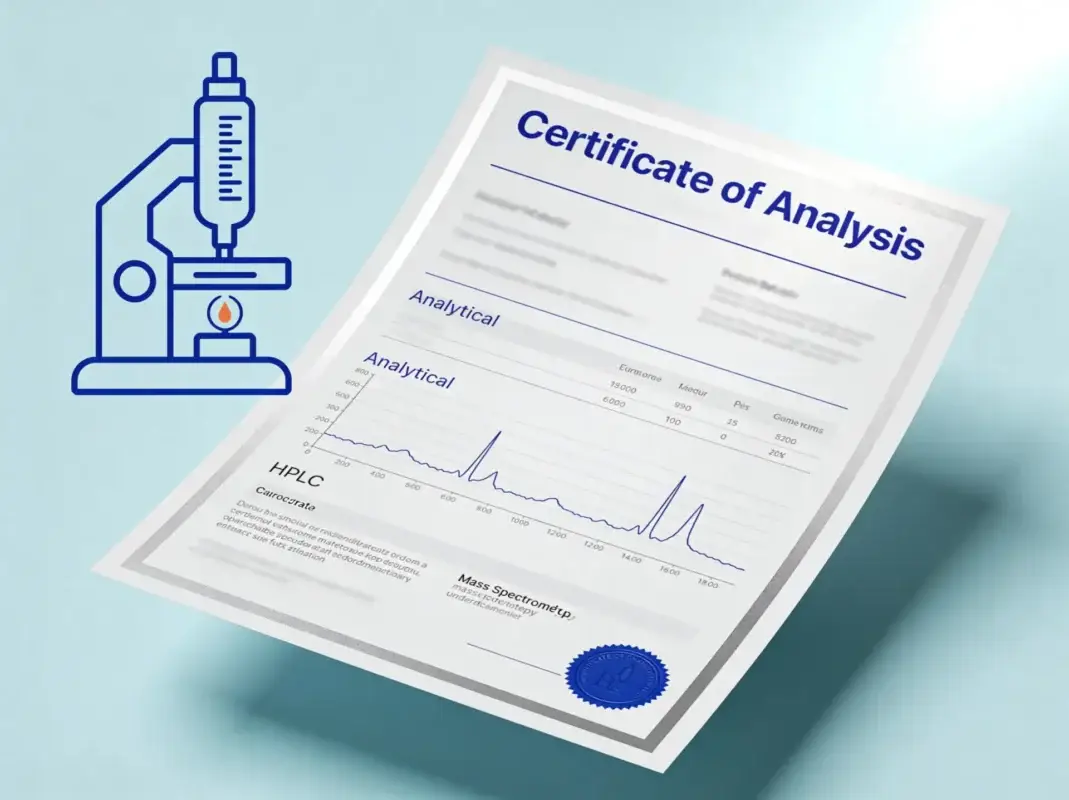
A Certificate of Analysis (COA) is a document that reports the results of analytical tests performed on a specific batch of a specific compound. It is not a generic product specification. It is not a manufacturer’s claim. It is a report from a laboratory documenting what its instruments measured when a sample was tested.
A credible COA has several non-negotiable structural elements:
Batch specificity. The document refers to a specific lot or batch number, not a generic product. Two vials from two different batches of the same compound will have different COAs.
Date of analysis. The testing date is recorded, and the COA cannot be dated before the manufacturing date of the batch it describes.
Laboratory identification. The testing laboratory is named, with sufficient detail to be independently verifiable.
Methodology references. The analytical methods used are identified (HPLC conditions, mass spectrometry configuration, and so on), allowing another laboratory to attempt to replicate the testing.
Analyst signature or authorization. The person or process responsible for releasing the results is recorded.
When any of these elements is missing or generic — for example, a document that lists “Peptide X, 99% purity” with no batch number, no date, and no methodology — the document is not functioning as a Certificate of Analysis. It is functioning as marketing copy that happens to be formatted to look like analytical data [Ref. 1].
The Three Tests That Matter Most
Peptide COAs can include dozens of tests, but three carry most of the analytical weight: HPLC purity, mass spectrometry, and the peptide content determination.
HPLC purity — what it tells you and what it doesn’t
High-performance liquid chromatography (HPLC) separates a sample by passing it through a column packed with material that interacts differently with different molecules. The peptide of interest and any impurities elute from the column at different times, and a detector measures how much of each substance comes through. The result is a chromatogram with peaks at characteristic retention times, and “HPLC purity” is the percentage of the total detector signal accounted for by the main peak [Ref. 2].
In practice, HPLC purity for research peptides typically falls between 95% and 99%. Pharmaceutical-grade peptides are typically 99%+ purity. Anything below 95% should prompt questions; anything claimed at 99.9%+ should also prompt questions, because that level of purity is difficult to achieve and even more difficult to measure reliably.
A critical limitation: HPLC purity reports what fraction of the detectable signal is the main peak, but cannot by itself confirm what the main peak actually is. A peak at the expected retention time could in principle be the labeled compound, a closely related sequence, or in rare cases a different compound entirely that happens to elute at the same time. HPLC purity is necessary but not sufficient.
Mass spectrometry — confirming identity
Mass spectrometry ionizes the sample and measures the mass-to-charge ratio of the resulting ions. The output identifies the molecular weight of the compound in the sample. This is the test that confirms identity: a peak at 4113 Da on a vial labeled Semaglutide confirms the compound matches Semaglutide’s expected molecular weight; a peak at 4814 Da on the same vial would indicate the vial actually contains Tirzepatide; a peak at 3751 Da would indicate liraglutide.
For peptides specifically, mass spectrometry is the single most reliable test for catching mislabeled or counterfeit products [Ref. 3]. The combination of HPLC purity (which says the sample is clean) and mass spectrometry (which says the sample is the right molecule) is what makes a COA analytically credible.
Peptide content — the most misunderstood metric
This is the most consequential metric on a COA, and the one most often misrepresented or omitted entirely.
Lyophilized peptides are never 100% peptide by mass. The dry powder in a vial contains the peptide itself plus counter-ions (typically trifluoroacetate or acetate from the synthesis process), residual water, and trace impurities. Peptide content — sometimes labeled “peptide assay” or “net peptide” — is the percentage of the vial’s mass that is actually the peptide.
A 5 mg vial of BPC-157 with 80% peptide content contains 4 mg of actual peptide and 1 mg of counter-ions and residual moisture. A 5 mg vial of the same compound with 95% peptide content contains 4.75 mg. This is not contamination; it is a normal feature of lyophilized peptide chemistry. But it materially affects dosing calculations in any research protocol designed around mass — if a researcher calculates a dose assuming 5 mg of peptide and the vial actually contains 4 mg, the experimental concentration is 20% below intended.
Reputable suppliers report HPLC purity and peptide content as separate numbers because they measure different things. Suppliers who report only purity, or who collapse the two into a single “purity” claim, are at minimum sloppy and at worst deliberately misleading [Ref. 4].
Red Flags on a Certificate of Analysis
Several patterns recur across questionable COAs.
Generic templates not batch-specific. A COA that does not reference a specific batch number, or that uses identical results across multiple batches, is not analytical documentation. It is a template.
Missing methodology. A credible HPLC report identifies the column, the mobile phase, the gradient, and the detector. A credible MS report identifies the ionization source and mass range. COAs that report results without methodology cannot be independently evaluated.
No analyst signature, no laboratory letterhead. Anonymous COAs are unverifiable by design.
Suspiciously high purity claims. 99.9%+ purity is rare and difficult to measure accurately. Any supplier claiming 99.9%+ across all products has either invested in extraordinary analytical capabilities or is overstating their results.
In-house testing without third-party verification. Manufacturers testing their own products have an inherent conflict of interest. Independent third-party testing exists specifically to remove that conflict.
COA dated before manufacture. A COA must be dated on or after the date the batch was synthesized. COAs dated before manufacture are not analyzing the batch they purport to describe.
Single-test COAs. A COA reporting only HPLC purity, with no mass spectrometry or peptide content data, leaves out the tests that catch the most consequential errors.
Reused COAs across products. If the COA for two different peptides shows identical chromatograms or identical mass spectra, the document is fraudulent on its face.
How Kinetic Compounds Verifies Each Batch
Kinetic Compounds tests every batch of every product through Janoshik Analytical, an independent third-party laboratory. Each COA is batch-specific and reports HPLC purity, mass spectrometry confirmation matching the expected molecular weight for the labeled compound, peptide content as a separate metric from peptide mass, and methodology details sufficient to allow independent replication.
Current COAs are published directly on each product page rather than provided on request. This is a deliberate transparency choice — a COA that has to be requested can be selectively withheld; a COA that is published with the product cannot.
The broader testing approach is documented on our lab testing and COA page, and the analytical standards we work to are documented on our quality standards page. Pharmaceutical specifications for peptide drug substances broadly follow the ICH Q6A guideline [Ref. 6], and reputable research-grade testing applies similar analytical principles.
For specific examples, researchers can review batch reports on our most-requested products: BPC-157, Semaglutide, Tirzepatide, and TB-500. The full research catalog is available through our shop.
Every Kinetic Compounds batch ships with a third-party Certificate of Analysis published directly on the product page. Review our complete testing methodology on the lab testing and COA page, or browse the full research peptide catalog to see current COAs for every product.
Related Peptides
Related peptides will load here via PHP snippet.
Available for Research
Research Tools
Quality Promise
very batch independently tested by Janoshik Analytical. 98% purity minimum.
Frequently Asked Questions
What is a Certificate of Analysis?
<p>A Certificate of Analysis is a document reporting the results of analytical tests performed on a specific batch of a specific compound. A credible COA is batch-specific, dated, identifies the testing laboratory, references methodology, and reports separate numbers for HPLC purity, mass spectrometry confirmation, and peptide content.</p>
What does HPLC purity actually measure?
<p>HPLC purity measures the percentage of the total detector signal accounted for by the main peak in a chromatographic separation. It tells you how clean the sample is, but does not by itself confirm what the main peak actually is.</p>
Why is mass spectrometry important on a COA?
<p>Mass spectrometry confirms the identity of the compound in the vial by measuring its molecular weight. Without mass spectrometry, a COA cannot definitively confirm that the vial contains the labeled compound rather than a different compound with similar HPLC behavior.</p>
What is the difference between peptide content and peptide mass?
<p>A 5 mg vial of peptide contains 5 mg of lyophilized powder. Peptide content is the percentage of that powder that is actually the peptide — typically 75% to 95%, with the remainder being counter-ions and residual moisture. The peptide mass equals total mass times peptide content. A 5 mg vial at 80% peptide content contains 4 mg of actual peptide.</p>
Can I trust a COA from the manufacturer?
<p>In-house COAs from the manufacturer reflect the manufacturer's own analytical claims. Independent third-party COAs reflect testing performed by a laboratory with no financial interest in the result. The two are not equivalent. Reputable suppliers provide third-party COAs for every batch.</p>
What if a supplier doesn't publish COAs on the product page?
<p>COAs available only on request can be selectively withheld for batches with disappointing results. Reputable suppliers publish current COAs directly on each product page, where they are visible to every potential buyer and updated as new batches are produced.</p>
Are higher-purity peptides always better for research?
<p>Higher purity reduces the risk of impurity-related artifacts in research data, which matters most for in vivo work and for studies involving sensitive cellular endpoints. For most research applications, purity above 95% is sufficient; pharmaceutical research generally requires 99%+. Purity claims above 99.9% should be treated with skepticism unless they come from a major analytical laboratory.</p>
References
- "Related impurities in peptide medicines." Journal of Pharmaceutical and Biomedical Analysis, 101:2-30. — D'Hondt M, Bracke N, Taevernier L, et al. (2014).
- "Manufacturing and Quality of Follow-on/Compounded GLP-1 Polypeptide Drugs." Pharmaceutical Research, 2024. — Hach M, et al. (2024).
- "Peptide therapeutics: current status and future directions." Drug Discovery Today, 20(1):122-128. — Fosgerau K, Hoffmann T (2015).
- FDA Guidance for Industry: ANDAs for Certain Highly Purified Synthetic Peptide Drug Products. — U.S. Food and Drug Administration (2021).
- ICH Q6A: Specifications: Test Procedures and Acceptance Criteria for New Drug Substances and New Drug Products. — International Council for Harmonisation.
- Fosgerau K & Hoffmann T, Drug Discovery Today, 2015 — "Peptide therapeutics: current status and future directions"
Continue Reading
For Research Use Only Products described on this site are intended for laboratory research purposes only. They are not approved by Health Canada for human consumption, diagnosis, treatment, or prevention of any medical condition.