
Home / Research Articles / Tirzepatide: The Dual-Agonist Peptide Researchers Need to Know
Tirzepatide: The Dual-Agonist Peptide Researchers Need to Know
Key Takeaways
- Tirzepatide is a 39-amino-acid synthetic peptide and the first approved dual GIP/GLP-1 receptor agonist.
- The compound has been studied across the SURPASS trials in type 2 diabetes and the SURMOUNT trials in obesity, with research now expanding into cardiovascular and heart failure domains.
- In the SURPASS-2 head-to-head trial, Tirzepatide produced larger reductions in HbA1c and body weight than once-weekly Semaglutide 1 mg.
- Tirzepatide is approved for human therapeutic use as Mounjaro and Zepbound; research-grade Tirzepatide is a separate product intended for laboratory research only.
- The dual-agonist mechanism extends Tirzepatide's research applications beyond glucose homeostasis into adipose biology, bone metabolism, and other GIP-receptor-mediated pathways.
Tirzepatide entered the research peptide landscape in 2018 as the first compound in a new pharmacological class: dual GIP and GLP-1 receptor agonists. Where Semaglutide and other GLP-1 analogs activate one incretin receptor, Tirzepatide activates two — and that mechanistic difference has translated into measurably different outcomes in head-to-head clinical research. The compound is approved for human therapeutic use as Mounjaro (type 2 diabetes) and Zepbound (obesity), both manufactured by Eli Lilly under pharmaceutical good manufacturing practices.
This article addresses Tirzepatide as a research compound, not as a therapeutic product. We cover the compound’s chemistry and dual-agonist mechanism, the clinical research base, how it compares mechanistically to Semaglutide, and the reconstitution, storage, and sourcing considerations researchers should understand before working with the compound.
What Is Tirzepatide?
Tirzepatide is a 39-amino-acid synthetic peptide that activates both the glucose-dependent insulinotropic polypeptide (GIP) receptor and the GLP-1 receptor. The molecular formula is C₂₂₅H₃₄₈N₄₈O₆₈, the molecular weight is approximately 4813.5 g/mol, and the CAS registry number is 2023788-19-2.
The compound was discovered by Eli Lilly researchers and first published in 2018 by Coskun and colleagues as LY3298176 [Ref. 1]. Its structural design draws on both native GIP and GLP-1 sequences, with modifications that produce balanced activity at both receptors while extending the half-life to approximately five days. A C20 fatty diacid linker attached to a lysine residue binds reversibly to serum albumin, slowing renal clearance — a mechanistic strategy similar to Semaglutide’s albumin-binding approach but with a longer fatty acid chain.
Two structural features distinguish Tirzepatide from previous GLP-1 mono-agonists. First, the peptide retains enough sequence homology to native GIP to engage the GIP receptor with high affinity. GIP, like GLP-1, is an incretin hormone secreted by the small intestine in response to food, but it acts on a different receptor and had historically been considered less promising as a pharmacological target until Tirzepatide demonstrated otherwise. Second, the GLP-1 receptor activity is biased toward G-protein signaling over β-arrestin recruitment, which has been hypothesized to contribute to the compound’s tolerability profile in research.
Tirzepatide gained regulatory approval as Mounjaro (subcutaneous, type 2 diabetes) in 2022 and as Zepbound (subcutaneous, obesity) in 2023. Research-grade Tirzepatide sold for laboratory research is the same compound chemically but is not manufactured under the pharmaceutical-grade conditions required for human therapeutic use.
Mechanism of Action
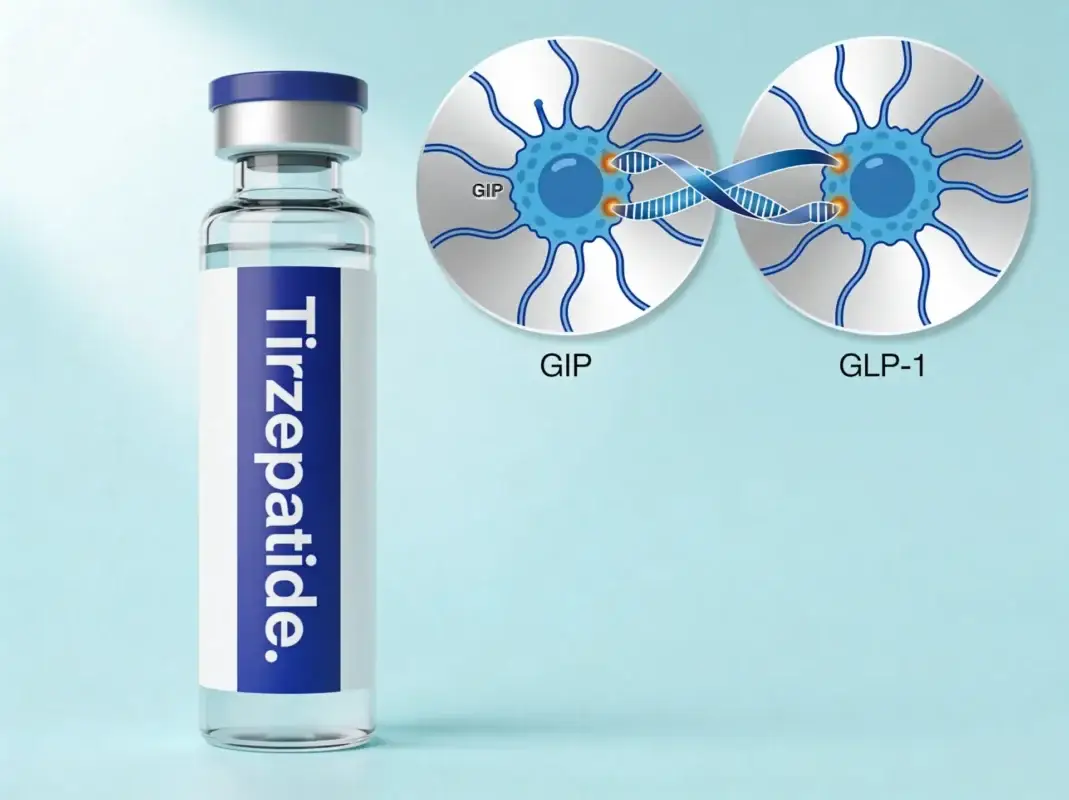
Tirzepatide’s dual-agonist mechanism is the compound’s defining feature in the research peptide landscape. Activation of both the GIP and GLP-1 receptors produces a set of effects that overlap with single-agonist GLP-1 activity but extend beyond it in measurable ways.
The GLP-1 receptor pathway in Tirzepatide produces the same four primary effects covered in the broader GLP-1 literature: glucose-dependent insulin secretion, glucagon suppression, delayed gastric emptying, and central satiety signaling. These effects underlie much of the compound’s observed metabolic activity.
The GIP receptor pathway adds several mechanistic threads not present in GLP-1-only agonists.
Adipose tissue effects. GIP receptors are expressed on adipocytes, where activation influences lipid storage, lipolysis, and insulin sensitivity. The role of GIP signaling in adipose biology is more nuanced than glucose homeostasis and remains an active area of investigation.
Bone metabolism. GIP receptors are present on osteoblasts and osteoclasts, and the GIP system has been studied for effects on bone formation and resorption — a research domain with no direct parallel in GLP-1-only literature.
Central nervous system effects. GIP receptors in the central nervous system contribute to appetite regulation and energy expenditure via pathways that appear complementary to GLP-1 signaling.
Synergistic insulin response. When both incretin receptors are activated simultaneously, the insulin response to glucose is amplified beyond what either receptor produces alone. This pharmacodynamic interaction is part of why dual agonism has been hypothesized to outperform single agonism in glycemic and weight outcomes.
A mechanism review by Min and Bain published in 2021 synthesizes the receptor pharmacology and the rationale for dual incretin agonism [Ref. 2]. For a single-receptor comparison, see our Semaglutide research deep dive, which covers GLP-1 receptor agonism in detail.
Research Applications
Tirzepatide’s research base, while shorter than Semaglutide’s, has expanded rapidly since the compound’s 2022 approval. The clinical trial program centers on two major series: SURPASS in type 2 diabetes and SURMOUNT in obesity.
Metabolic and glycemic research
The SURPASS trial program tested Tirzepatide across a range of comparators in type 2 diabetes, including placebo, insulin, and other GLP-1 agonists. SURPASS-2, published by Frias and colleagues in the New England Journal of Medicine in 2021, is the head-to-head comparison most relevant to the broader GLP-1 research landscape: Tirzepatide was tested directly against once-weekly Semaglutide 1 mg, with statistically significant superiority for Tirzepatide across HbA1c reduction and body weight outcomes at all three doses tested [Ref. 3]. SURPASS-2 remains a foundational citation for any researcher comparing the two compounds.
Weight management and obesity
The SURMOUNT trial program tested Tirzepatide at obesity-relevant doses. SURMOUNT-1, published by Jastreboff and colleagues in the New England Journal of Medicine in 2022, demonstrated approximately 20% mean body weight reduction at week 72 in subjects with overweight or obesity — a notably larger effect than the approximately 15% observed in the corresponding Semaglutide STEP 1 trial [Ref. 4]. Subsequent SURMOUNT trials examined Tirzepatide in subjects with type 2 diabetes (SURMOUNT-2) and in weight-loss maintenance after lead-in (SURMOUNT-4) [Ref. 5].
Cardiovascular and heart failure research
The SURPASS-CVOT and SUMMIT trial programs extended Tirzepatide research into cardiovascular outcomes. SUMMIT, published by Packer and colleagues in 2024, examined Tirzepatide in subjects with obesity and heart failure with preserved ejection fraction (HFpEF) — a population with limited pharmacological options [Ref. 6]. Cardiovascular outcome data continues to accumulate across the broader program.
Emerging applications
As with Semaglutide, ongoing research is examining Tirzepatide in chronic kidney disease, steatotic liver disease, obstructive sleep apnea (SURMOUNT-OSA), and other metabolic-adjacent conditions. The dual-agonist mechanism has prompted particular interest in domains where GIP signaling specifically may matter, including bone biology and adipose tissue research.
Across all research domains, research-grade Tirzepatide is intended for laboratory and academic research. Clinical applications use the approved pharmaceutical products under medical supervision.
Dosing & Reconstitution for Research
Researchers working with lyophilized Tirzepatide reconstitute the compound with bacteriostatic water before use. The math follows the same concentration-equals-mass-divided-by-volume principle as other research peptides, with adjustments for Tirzepatide’s high molecular weight (4813.5 g/mol — approximately 17% larger than Semaglutide and several times larger than most short research peptides).
A 10 mg vial reconstituted with 2 mL of bacteriostatic water yields 5 mg/mL — equivalent to approximately 1039 nmol/mL. A 5 mg vial in 2 mL yields 2.5 mg/mL or approximately 520 nmol/mL. As with other large peptides, molar concentrations are substantially lower for a given mass than for smaller compounds, and researchers should calculate in molar units when designing comparative protocols across different peptides.
Reconstitution technique mirrors that for other research peptides: inject bacteriostatic water down the inner wall of the vial rather than directly onto the lyophilized powder, then swirl gently until dissolved. Direct injection onto powder can cause foaming and may complicate accurate concentration measurement.
Researchers can verify their concentration math against our peptide reconstitution calculator, which handles the conversion between mass and molar units automatically.
This article does not provide dosing guidance for any therapeutic indication. Tirzepatide dosing for human therapeutic purposes requires medical supervision and the use of approved pharmaceutical products.
Storage & Handling
Lyophilized Tirzepatide is stable at room temperature during shipping but should be moved to long-term storage at -20°C (-4°F), protected from light, on receipt. Under proper lyophilized conditions, the compound remains stable for 24 months or longer.
Once reconstituted, Tirzepatide should be stored at 2–8°C and used within 28 days. The C20 diacid modification provides additional stability against enzymatic degradation in solution, but does not eliminate the need for proper cold storage. Repeated freeze-thaw cycles degrade peptide integrity and should be avoided.
Every vial should be visually inspected before use. The reconstituted solution should be clear and free of particulates. Cloudiness, discoloration, or visible sediment indicates degradation, and the vial should not be used in research.
For full handling protocols across the broader peptide catalog, see our storage and reconstitution guide.
Sourcing Verified Tirzepatide for Research
Tirzepatide is among the most commercially valuable research peptides in current circulation, which has created strong economic incentives for counterfeit production. Independent testing data from grey-market suppliers regularly reveals products labeled “Tirzepatide” that contain incorrect peptide sequences, related GLP-1 mono-agonists (sometimes Semaglutide), substantially below-labeled peptide content, or in some cases no Tirzepatide at all.
A credible Certificate of Analysis for Tirzepatide should show three things at minimum: HPLC purity expressed as a percentage, mass spectrometry confirmation matching Tirzepatide’s molecular weight of approximately 4813.5 g/mol, and an explicit distinction between peptide content and peptide mass. The mass spectrometry confirmation is particularly important here — a peak at 4813.5 Da confirms Tirzepatide, while a peak corresponding to Semaglutide (approximately 4113 Da) indicates the vial contains a different compound entirely.
Kinetic Compounds publishes the full Certificate of Analysis for every batch of Tirzepatide, with all testing performed by Janoshik Analytical, an independent third-party laboratory. Researchers can review the current batch report on the Tirzepatide product page, and our broader testing methodology is documented on our lab testing and COA page.
For researchers comparing GIP/GLP-1 dual agonism to single-receptor agonism or to next-generation triple agonism, our Semaglutide and Retatrutide glossary entries cover the relevant mechanistic comparisons. The full GLP-1 and metabolic research peptide catalog lists all related compounds with current Certificates of Analysis.
For approved pharmaceutical Tirzepatide intended for human therapeutic use, researchers and clinicians should obtain Mounjaro or Zepbound through regular pharmaceutical channels. Research-grade Tirzepatide is not a substitute for these products in any clinical context.
Comparing the GLP-1 receptor agonist class for research? Our complete GLP-1 and metabolic research peptide catalog covers Semaglutide, Tirzepatide, Retatrutide, and related compounds — all independently lab-tested with current Certificates of Analysis available.
Related Peptides
Related peptides will load here via PHP snippet.
Available for Research
Research Tools
Quality Promise
very batch independently tested by Janoshik Analytical. 98% purity minimum.
Frequently Asked Questions
What is Tirzepatide?
<p>Tirzepatide is a 39-amino-acid synthetic peptide and a dual GIP/GLP-1 receptor agonist. It is the first compound in its pharmacological class and has been studied across the SURPASS trials in type 2 diabetes and the SURMOUNT trials in obesity. It is approved for human therapeutic use as Mounjaro and Zepbound.</p>
How does Tirzepatide differ from Semaglutide?
<p>Semaglutide is a single-receptor GLP-1 agonist. Tirzepatide activates both the GIP and GLP-1 receptors, which extends its mechanism into pathways — including adipose biology and bone metabolism — that single-agonist GLP-1 analogs do not engage. In the head-to-head SURPASS-2 trial, Tirzepatide produced larger reductions in HbA1c and body weight than once-weekly Semaglutide 1 mg.</p>
How does research-grade Tirzepatide differ from Mounjaro and Zepbound?
<p>Mounjaro and Zepbound are pharmaceutical products manufactured by Eli Lilly under pharmaceutical good manufacturing practices. They are produced as sterile injectable formulations, packaged for clinical dosing, and intended for therapeutic use under medical supervision. Research-grade Tirzepatide is the same compound chemically but is not manufactured to pharmaceutical-grade standards and is intended for laboratory research only.</p>
What is the mechanism of Tirzepatide?
<p>Tirzepatide activates both the GIP receptor and the GLP-1 receptor. GLP-1 receptor activation produces glucose-dependent insulin secretion, glucagon suppression, delayed gastric emptying, and central satiety signaling. GIP receptor activation adds effects on adipose tissue, bone metabolism, and central appetite regulation. Simultaneous activation produces a synergistic insulin response.</p>
Why does Tirzepatide have such a long half-life?
<p>Tirzepatide carries a C20 fatty diacid linker that binds reversibly to serum albumin, slowing renal clearance. The structural modifications also resist degradation by dipeptidyl peptidase-4 (DPP-4). Together, these confer a half-life of approximately five days.</p>
Is Tirzepatide legal in Canada?
<p>Tirzepatide is approved by Health Canada for human therapeutic use as Mounjaro. Research-grade Tirzepatide is legal to purchase and possess in Canada for laboratory research purposes only. Use of research-grade Tirzepatide for human consumption is outside legal scope and is not supervised by Health Canada.</p>
How is Tirzepatide reconstituted for research?
<p>Lyophilized Tirzepatide is reconstituted with bacteriostatic water. A 10 mg vial in 2 mL of bacteriostatic water yields 5 mg/mL. Researchers can verify calculations using our reconstitution calculator.</p>
References
- "LY3298176, a novel dual GIP and GLP-1 receptor agonist for the treatment of type 2 diabetes mellitus: From discovery to clinical proof of concept." Molecular Metabolism, 18:3-14. — Coskun T, Sloop KW, Loghin C, et al. (2018).
- "The Role of Tirzepatide, Dual GIP and GLP-1 Receptor Agonist, in the Management of Type 2 Diabetes: The SURPASS Clinical Trials." Diabetes Therapy, 12(1):143-157. — Min T, Bain SC (2021).
- "Tirzepatide versus Semaglutide Once Weekly in Patients with Type 2 Diabetes." New England Journal of Medicine, 385(6):503-515. — Frias JP, Davies MJ, Rosenstock J, et al. (2021).
- "Tirzepatide versus Semaglutide Once Weekly in Patients with Type 2 Diabetes." New England Journal of Medicine, 385(6):503-515. — Frias JP, Davies MJ, Rosenstock J, et al. (2021).
- "Continued Treatment With Tirzepatide for Maintenance of Weight Reduction in Adults With Obesity: The SURMOUNT-4 Randomized Clinical Trial." JAMA, 331(1):38-48. — Aronne LJ, Sattar N, Horn DB, et al. (2024).
- "Tirzepatide for Heart Failure with Preserved Ejection Fraction and Obesity." New England Journal of Medicine, 392(5):427-437. — Packer M, Zile MR, Kramer CM, et al. (2024).
Continue Reading
For Research Use Only Products described on this site are intended for laboratory research purposes only. They are not approved by Health Canada for human consumption, diagnosis, treatment, or prevention of any medical condition.