
Home / Research Articles / BPC-157 vs TB-500: A Research Comparison
BPC-157 vs TB-500: A Research Comparison
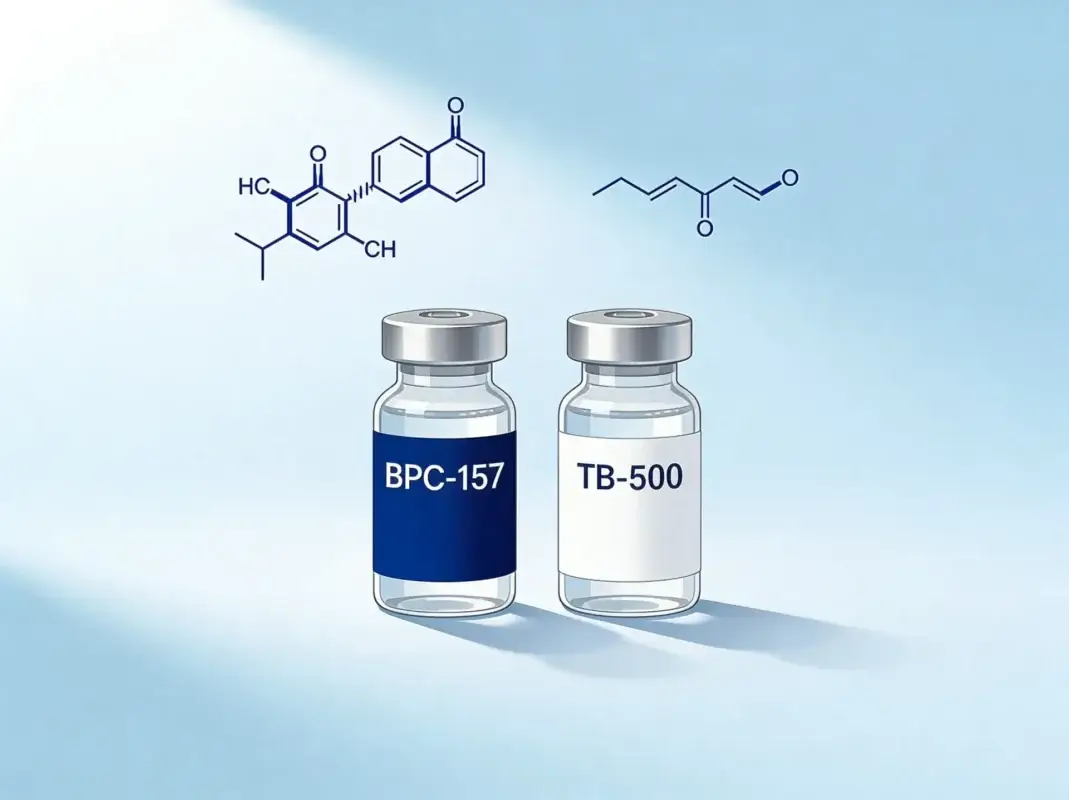
Key Takeaways
- BPC-157 and TB-500 are both research peptides studied for tissue repair, but they act through distinct mechanisms.
- BPC-157 is a 15-amino-acid pentadecapeptide derived from gastric juice; TB-500 is a 7-amino-acid synthetic fragment of Thymosin Beta-4.
- BPC-157's primary mechanism involves growth hormone receptor upregulation and VEGFR2-driven angiogenesis; TB-500 acts through actin sequestration and cell migration.
- BPC-157 has the deeper literature in gastrointestinal and tendon research; TB-500 has stronger cardiac repair and general wound healing data.
- Both compounds are intended exclusively for laboratory research and are not approved for human therapeutic use.
Researchers comparing BPC-157 and TB-500 face a deceptively simple question: which compound is right for which tissue repair application? Both peptides have generated substantial preclinical interest in healing and regeneration models, and both appear regularly in research protocol design. But their structural origins, mechanisms of action, and bodies of supporting literature differ in meaningful ways — differences that matter when matching a peptide to a research question. This article examines BPC-157 and TB-500 side by side: how each is structured, how each acts on tissue, where the research literatures overlap, where they diverge, and how researchers combine them when relevant.
For deeper background on either compound individually, our Complete BPC-157 Research Guide covers BPC-157 in greater depth, and the TB-500 glossary entry serves as a quick-reference summary.
At-a-Glance Comparison
| Attribute | BPC-157 | TB-500 |
|---|---|---|
| Compound type | Synthetic pentadecapeptide | Synthetic 7-amino-acid fragment |
| Amino acid count | 15 | 7 (active fragment of TB-4’s 44 amino acids) |
| Sequence | GEPPPGKPADDAGLV | Ac-LKKTETQ |
| Derived from | Protective protein in human gastric juice | Thymosin Beta-4 (cytoplasmic protein in nearly all cells) |
| Half-life | ~4 hours in plasma | Shorter; varies by source |
| Primary mechanism | GH receptor upregulation; VEGFR2 angiogenesis | Actin sequestration; cell migration |
| Strongest research areas | GI, tendon, musculoskeletal | Wound healing, cardiac repair, cell migration |
| Regulatory status | Research use only | Research use only |
How BPC-157 Works
BPC-157 is a 15-amino-acid synthetic peptide derived from a partial sequence of a larger protective protein in human gastric juice. The compound’s most-characterized mechanism centers on growth hormone receptor upregulation — particularly in tendon fibroblasts, where it has been shown to promote cell survival, migration, and outgrowth [Ref. 1]. This pathway is the leading candidate for explaining BPC-157’s effects in musculoskeletal injury models.
A second mechanistic thread involves vascular endothelial growth factor receptor 2 (VEGFR2) upregulation, which drives angiogenesis in ischemic tissue models. New blood vessel formation appears across the BPC-157 literature as a recurring intermediate step in the broader tissue repair findings.
A 2024 review by Sikirić and colleagues in Pharmaceuticals synthesizes BPC-157’s pleiotropic activity across multiple organ systems, with particular attention to neurotransmitter system interactions and central nervous system models [Ref. 2].
For a complete breakdown of BPC-157’s structural origins, full mechanism, and research applications, see our BPC-157 Complete Research Guide.
How TB-500 Works
TB-500 is a synthetic 7-amino-acid fragment of Thymosin Beta-4 (TB-4), a 44-amino-acid peptide that occurs naturally in nearly all human cells. The active fragment — sometimes labeled the “actin-binding domain” — retains many of TB-4’s biological effects while being more practical to synthesize and administer in research contexts.
The compound’s primary mechanism is actin sequestration. TB-500 binds monomeric G-actin and regulates actin polymerization, which influences cell motility, migration, and proliferation [Ref. 3]. This makes the compound mechanistically distinct from BPC-157: where BPC-157 acts on receptor expression and angiogenic signaling, TB-500 acts on the cytoskeletal machinery that allows cells to move and reorganize during tissue repair.
Beyond actin binding, TB-500 has been studied for anti-inflammatory effects, anti-apoptotic activity, and promotion of cell migration into wound sites — particularly endothelial cells and stem cell populations.
One important caveat for researchers: many products labeled “TB-500” actually contain full-length Thymosin Beta-4 rather than the 7-amino-acid fragment. These are distinct molecules. Lab analytical data — specifically HPLC purity and mass spectrometry confirmation — is the only way to verify what’s in a given vial. Our TB-500 product page publishes the full Certificate of Analysis for each batch.
Where They Overlap
Both compounds are studied primarily in tissue-repair contexts, and their research literatures share several core domains.
Wound healing. Both peptides appear in wound-healing models — BPC-157 across multiple tissue types, TB-500 with particular depth in corneal and skin healing models. A 2021 review by Seiwerth and colleagues in Frontiers in Pharmacology surveys the BPC-157 wound-healing literature in detail [Ref. 4], while the parent TB-4 literature includes substantial corneal wound healing research.
Angiogenesis. Both compounds promote new blood vessel formation, though through different mechanisms. BPC-157 acts through VEGFR2 upregulation; TB-500 promotes angiogenesis as a downstream consequence of actin reorganization and endothelial cell migration.
Musculoskeletal repair. Both peptides have been examined in tendon and muscle injury models, making them natural candidates for direct comparison in injury-recovery research.
Anti-inflammatory effects. Both compounds modulate inflammatory cytokine activity, though through distinct upstream pathways.
Where They Differ
The key distinctions matter when selecting a compound for a specific research question.
Gastrointestinal research. BPC-157 has a deep and well-established GI literature — the original research direction, motivated by the compound’s gastric-juice origin. TB-500 is not a major player in GI research models.
Cardiac repair. TB-500 and its parent TB-4 have a substantial cardiovascular research base. Work by Smart and colleagues, published in Nature in 2007, established TB-4’s role in cardiac progenitor cell mobilization and post-infarct repair [Ref. 5]. BPC-157 has comparatively less cardiac-specific literature.
Tendon-fibroblast mechanism. BPC-157’s growth hormone receptor upregulation pathway in tendon fibroblasts is a specific, well-characterized mechanism with no direct TB-500 equivalent.
Structural origin. BPC-157 is derived from a human gastric protein; TB-500 is derived from a cytoplasmic protein found across nearly all cell types. These different evolutionary origins influence which research questions each peptide is naturally suited to.
Combination Research
A subset of preclinical protocols examines BPC-157 and TB-500 in combination — typically in tissue-repair models where researchers want to test whether mechanistic complementarity (receptor upregulation plus actin sequestration) produces additive or synergistic effects.
The rationale is straightforward: BPC-157 drives growth factor signaling and new blood vessel formation; TB-500 drives cell migration into the area being supplied by those new vessels. In principle, these mechanisms operate on different stages of tissue repair and may be cumulatively beneficial.
Researchers running combination protocols can source pre-blended material to ensure consistent ratios across experimental conditions. Our BPC-157 + TB-500 Blend ships both peptides in a single vial with full Certificate of Analysis data covering both compounds.
One important caveat: combination protocols have not been studied in human clinical trials, and the preclinical combination literature is much thinner than the literature on each compound alone. Researchers should treat combination data with the same caution applied to single-compound data — rodent and in vitro findings do not translate directly to human outcomes.
Choosing Between Them for Specific Research Applications
Practical guidance based on what each compound’s literature actually supports:
Tendon, ligament, or muscle injury models — BPC-157 has the deeper musculoskeletal literature, particularly for tendon-to-bone healing and muscle crush injury.
Gastrointestinal models — BPC-157, with no real TB-500 alternative in this domain.
Cardiac or cardiovascular models — TB-500 (or full-length TB-4) has the more substantial cardiac repair literature.
General wound healing or corneal models — Either compound is reasonable. TB-500 has particularly strong corneal healing data; BPC-157 has broader cross-tissue applicability.
Cell migration studies — TB-500’s actin-binding mechanism makes it the more direct mechanistic choice.
Angiogenesis studies — BPC-157’s VEGFR2 pathway is the more direct mechanism, though TB-500 also affects vascular remodeling indirectly through endothelial cell migration.
Combination protocols — When researchers want to examine multiple repair pathways simultaneously, both compounds together have a small but growing body of preclinical work.
Researchers calculating concentrations for either compound can verify their math against our peptide reconstitution calculator, which handles bacteriostatic water dilution automatically.
Sourcing Lab-Tested BPC-157 and TB-500
Both peptides are commonly mislabeled or under-purified in the grey-market peptide trade. For BPC-157, common issues include peptide content significantly below labeled mass, related-sequence contamination, and outright misidentification. For TB-500, the most common issue is products labeled “TB-500” actually containing full-length Thymosin Beta-4 — a structurally different molecule that may not produce the research outcomes documented in the TB-500 fragment literature.
A credible Certificate of Analysis for either compound should show three things at minimum: HPLC purity expressed as a percentage, mass spectrometry confirmation matching the expected molecular weight, and an explicit distinction between peptide content and peptide mass.
Kinetic Compounds publishes the full Certificate of Analysis for every batch, with all testing performed by Janoshik Analytical. Current batch reports are available on the BPC-157 and TB-500 product pages, and our BPC-157 + TB-500 Blend ships with COA data covering both compounds. Our broader testing methodology is documented on our lab testing and COA page, and the full healing and recovery research peptide catalog lists all related compounds.
Running a combination research protocol? Our pre-blended BPC-157 + TB-500 product ships both peptides in a single vial with full analytical documentation covering both compounds → View the BPC-157 + TB-500 Blend
Related Peptides
Related peptides will load here via PHP snippet.
Available for Research
Research Tools
Quality Promise
very batch independently tested by Janoshik Analytical. 98% purity minimum.
Frequently Asked Questions
What's the main difference between BPC-157 and TB-500?
<p>BPC-157 is a 15-amino-acid peptide derived from human gastric juice that acts primarily through growth hormone receptor upregulation and VEGFR2-driven angiogenesis. TB-500 is a 7-amino-acid fragment of Thymosin Beta-4 that acts through actin sequestration and cell migration. Both are studied in tissue repair contexts but through distinct mechanisms.</p>
Can BPC-157 and TB-500 be combined in research protocols?
<p>Some preclinical protocols examine the two compounds together, based on the rationale that their mechanisms — receptor signaling versus cytoskeletal regulation — may complement each other in tissue repair models. Combination data is much more limited than single-compound data, and findings should be treated with appropriate caution.</p>
Which peptide is studied more in tissue repair research?
<p>Both have substantial tissue-repair literatures, but the focus differs. BPC-157 has deeper musculoskeletal and gastrointestinal research; TB-500 has stronger cardiac repair and general wound healing data.</p>
Is TB-500 the same as Thymosin Beta-4?
<p>No. TB-500 is a synthetic 7-amino-acid fragment of Thymosin Beta-4, which itself is a 44-amino-acid naturally occurring peptide. Many products labeled "TB-500" actually contain full-length Thymosin Beta-4 — analytical data is the only way to verify which is in a given vial.</p>
How are BPC-157 and TB-500 reconstituted?
<p>Both lyophilized peptides are reconstituted with bacteriostatic water. Concentration is determined by vial mass divided by diluent volume. Our peptide reconstitution calculator handles the math automatically for either compound.</p>
Are BPC-157 and TB-500 legal in Canada?
<p>Both compounds are legal to purchase and possess in Canada for laboratory research purposes only. Neither is approved by Health Canada for human therapeutic use, and any sale, marketing, or use for human consumption is outside legal scope.</p>
Where can I find Certificates of Analysis for both peptides?
<p>Kinetic Compounds publishes batch-specific Certificates of Analysis from Janoshik Analytical on every product page. COAs can also be requested directly via research@kineticcompounds.com.</p>
References
- Ref. 1 — Chang CH, Tsai WC, Hsu YH, Pang JH (2011). "The promoting effect of pentadecapeptide BPC 157 on tendon healing involves tendon outgrowth, cell survival, and cell migration." Journal of Applied Physiology, 110(3):774-780.
- Ref. 2 — Sikirić P, Boban Blagaic A, Strbe S, et al. (2024). "The Stable Gastric Pentadecapeptide BPC 157 Pleiotropic Beneficial Activity and Its Possible Relations with Neurotransmitter Activity." Pharmaceuticals (Basel), 17(4):461.
- Ref. 3 — Goldstein AL, Hannappel E, Sosne G, Kleinman HK (2012). "Thymosin β4: a multi-functional regenerative peptide. Basic properties and clinical applications." Expert Opinion on Biological Therapy, 12(1):37-51.
- Ref. 4 — Seiwerth S, Milavic M, Vukojevic J, et al. (2021). "Stable Gastric Pentadecapeptide BPC 157 and Wound Healing." Frontiers in Pharmacology, 12:627533.
- Ref. 5 — Smart N, Risebro CA, Melville AAD, et al. (2007). "Thymosin β4 induces adult epicardial progenitor mobilization and neovascularization." Nature, 445(7124):177-182.
- Ref. 6 — Sosne G, Qiu P, Goldstein AL, Wheater M (2010). "Biological activities of thymosin β4 defined by active sites in short peptide sequences." FASEB Journal, 24(7):2144-2151.
Continue Reading
For Research Use Only Products described on this site are intended for laboratory research purposes only. They are not approved by Health Canada for human consumption, diagnosis, treatment, or prevention of any medical condition.