
Home / Research Articles / BPC-157: The Complete Research Guide
BPC-157: The Complete Research Guide
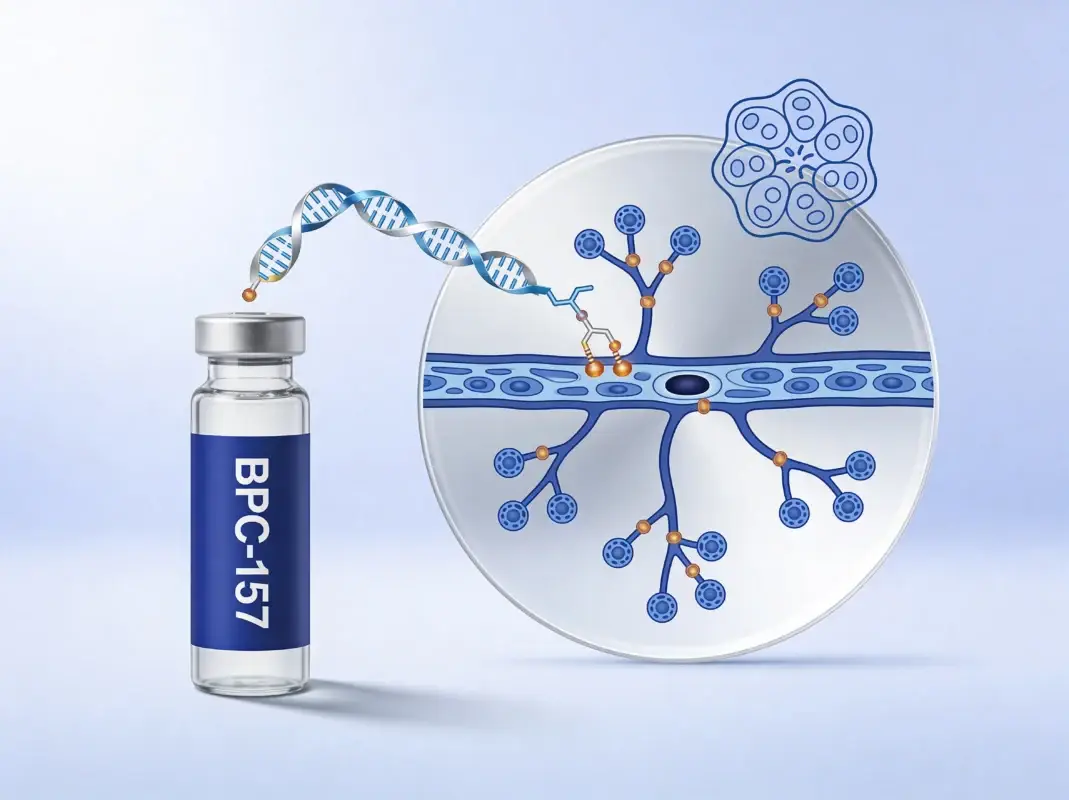
Key Takeaways
- BPC-157 is a 15-amino-acid synthetic peptide derived from a protective protein found in human gastric juice.
- Preclinical research has examined BPC-157 across tissue repair, gastrointestinal protection, angiogenesis, and neurological models.
- The compound's most-studied mechanism involves growth hormone receptor upregulation in tendon fibroblasts and VEGFR2-driven angiogenesis.
- BPC-157 is intended exclusively for laboratory research and is not approved for human therapeutic use by any regulatory agency.
- Independent third-party purity verification — such as Janoshik Analytical Certificates of Analysis — is the standard for sourcing research-grade BPC-157.
Few research peptides have generated the volume of preclinical investigation BPC-157 has accumulated over the past three decades — and few are as frequently misrepresented online. Much of the popular discussion conflates findings from rodent models with human outcomes the literature does not actually support. This guide takes a different approach: it treats the BPC-157 peptide as what it is — a synthetic pentadecapeptide with a substantial but still-developing preclinical record, intended exclusively for laboratory research. For a quick-reference summary, see our BPC-157 glossary entry.
Below, we examine BPC-157’s structural origins, the mechanisms preclinical work has characterized, the four research domains where it has been most actively studied, and the reconstitution and storage considerations researchers should understand before working with the compound.
What Is BPC-157?
BPC-157, short for Body Protection Compound-157 (also referenced in the research literature as PL 14736 or Bepecin), is a synthetic pentadecapeptide — a chain of fifteen amino acids arranged in the sequence GEPPPGKPADDAGLV. It carries a molecular weight of 1419.5 g/mol, the molecular formula C₆₂H₉₈N₁₆O₂₂, and the CAS registry number 137525-51-0.
The compound is a partial sequence derived from a larger protective protein naturally present in human gastric juice. It was first identified and characterized in the early 1990s by Predrag Sikirić and colleagues at the University of Zagreb, whose laboratory has since published the majority of the foundational BPC-157 research.
The gastric origin matters more than it might first appear. Most peptides degrade rapidly in stomach acid, which limits how they can be administered in research models. BPC-157 is unusual in that it remains stable in acidic conditions — a property that has made it the focus of studies exploring both injectable and oral research applications in animal models. The compound does not occur naturally in its 15-amino-acid form; it is produced synthetically for laboratory research.
Mechanism of Action
BPC-157’s mechanisms of action are not fully resolved. The compound appears to act on several distinct pathways rather than through a single receptor, which is part of why preclinical research has explored such a wide range of applications. Five mechanistic threads recur across the literature.
The most extensively studied is BPC-157’s effect on growth hormone receptor expression in tendon fibroblasts. In a 2011 study published in the Journal of Applied Physiology, Chang and colleagues demonstrated that BPC-157 upregulates GH receptor expression and promotes tendon fibroblast outgrowth, survival, and migration in vitro [Ref. 1]. This pathway is the leading candidate for explaining BPC-157’s effects in musculoskeletal injury models.
A second pathway involves modulation of the nitric oxide (NO) system. Preclinical work indicates that BPC-157 influences NO production and vascular tone, which has been proposed as a contributor to its observed effects on tissue perfusion and ulcer healing.
Third, BPC-157 has been shown to upregulate vascular endothelial growth factor receptor 2 (VEGFR2) and promote angiogenesis in models of ischemic injury [Ref. 2]. New blood vessel formation appears to be a recurring intermediate step in the tissue repair findings reported across multiple study designs.
Fourth, central nervous system studies have documented interactions with the dopaminergic and serotonergic systems, providing a mechanistic basis for the neurological models discussed below. A 2024 review by Sikirić and colleagues in Pharmaceuticals synthesizes the pleiotropic activity literature and its potential connections to neurotransmitter systems [Ref. 3].
Finally, in gastrointestinal models, BPC-157 stabilizes gut barrier function and modulates inflammatory cytokine activity — consistent with the compound’s gastric origin.
These pathways have been characterized primarily in rodent models and in vitro systems. Human clinical data remains limited, and researchers should interpret mechanistic findings within that boundary.
Research Applications
Preclinical research on BPC-157 has clustered into four primary domains, each with its own body of evidence and methodological conventions. A comprehensive 2021 review by Seiwerth and colleagues in Frontiers in Pharmacology synthesizes findings across vascular, gastrointestinal, tendon, and wound-healing applications [Ref. 4].
Musculoskeletal repair
The musculoskeletal literature is BPC-157’s most active research area outside gastroenterology. Studies have examined tendon-to-bone healing in surgical reattachment models, Achilles tendon transection recovery, ligament reconstruction outcomes, and muscle crush injury repair in rodent subjects. Work by Krivić and colleagues on tendon-to-bone healing [Ref. 5], and by Novinscak and colleagues on muscle crush injury [Ref. 6], established much of the methodological foundation for this research direction. Researchers comparing BPC-157 with related tissue-repair compounds such as TB-500 often examine both peptides in parallel injury models.
Gastrointestinal research
The GI literature is BPC-157’s deepest and longest-running body of work. This was the original research direction, motivated by the compound’s gastric-juice origin. Studies have explored protective effects in gastric ulcer models, inflammatory bowel disease models, and intestinal anastomosis healing — the last referring to the surgical reconnection of bowel segments. The 2011 review by Sikirić and colleagues in Current Pharmaceutical Design remains the standard reference for this body of work [Ref. 7].
Vascular and angiogenic studies
A smaller but growing body of work has examined BPC-157’s effects on angiogenesis following ischemic injury. These studies connect mechanistically to the VEGFR2 pathway discussed above and suggest that new blood vessel formation is a recurring intermediate step in the compound’s observed tissue-repair findings.
Neurological models
The most preliminary of BPC-157’s research domains, neurological work has examined effects in traumatic brain injury, spinal cord injury, and neurotransmitter system modulation. Findings here are early-stage and confined almost entirely to rodent models. The dopaminergic and serotonergic interactions noted in the mechanism section are the principal threads researchers have followed.
Across all four domains, the same caveat applies: BPC-157 has not been approved for human therapeutic use by any regulatory agency. It is intended exclusively for laboratory research.
Dosing & Reconstitution for Research
Researchers working with lyophilized BPC-157 must reconstitute the compound with bacteriostatic water before use. The math is straightforward but consequential: errors in calculation compromise the reproducibility of any study that follows.
The basic principle is concentration equals mass divided by volume. A 5 mg vial reconstituted with 2 mL of bacteriostatic water yields a working concentration of 2.5 mg/mL. The same 5 mg vial reconstituted with 1 mL yields 5 mg/mL. Choice of dilution volume is usually driven by the precision of the syringe being used and the volume per measured aliquot the protocol calls for.
Bacteriostatic water is the appropriate diluent for most research applications. It contains 0.9% benzyl alcohol, which suppresses bacterial growth and extends the usable life of reconstituted peptide compared to sterile water without preservative. For short-duration single-use protocols, sterile water can be substituted, but bacteriostatic water is standard for any setup involving multiple draws from the same vial.
Reconstitution should be performed by injecting the diluent slowly down the inner wall of the vial rather than directly onto the lyophilized powder. Direct injection onto the powder can cause foaming, which complicates accurate concentration measurement and may damage peptide structure. After reconstitution, the vial should be gently swirled — not shaken — until the powder is fully dissolved.
Researchers can verify their concentration math against our peptide reconstitution calculator, which handles the conversion automatically and accounts for target concentration, dilution volume, and syringe unit markings.
Storage & Handling
Lyophilized BPC-157 is stable at room temperature for the duration of standard shipping but should be moved to long-term storage at -20°C (-4°F), protected from light, on receipt. Under proper lyophilized storage conditions, the compound remains stable for 24 months or longer.
Once reconstituted, BPC-157 should be stored at 2–8°C — standard refrigerator temperature — and used within 28 days. Repeated freeze-thaw cycles degrade peptide integrity and should be avoided. Researchers planning to draw from a reconstituted vial across multiple sessions should consider aliquoting into smaller volumes immediately after reconstitution to minimize freeze-thaw exposure.
Every vial should be visually inspected before use. The reconstituted solution should be clear and free of particulates. Cloudiness, discoloration, or visible sediment indicates degradation, and the vial should not be used in research.
For full handling protocols across the broader peptide catalog, see our storage and reconstitution guide.
Sourcing Verified BPC-157 for Research
Peptide quality is the most consistently underestimated variable in research protocol design. Independent testing data from grey-market suppliers regularly reveals significant gaps between labeled and actual peptide content, contamination with related sequences, and outright misidentification — none of which is visible on the vial itself.
A credible Certificate of Analysis shows three things at minimum: HPLC purity expressed as a percentage, mass spectrometry confirmation matching the expected molecular weight, and a clear distinction between peptide content and peptide mass. The last point is frequently misunderstood. A 5 mg vial of “BPC-157” with 80% peptide content contains 4 mg of actual peptide, with the remainder consisting of counter-ions and residual moisture from synthesis. This is normal for lyophilized peptides — but only verifiable when proper analytical data is published with each batch.
Kinetic Compounds publishes the full Certificate of Analysis for every batch of BPC-157, with all testing performed by Janoshik Analytical, an independent third-party laboratory. Researchers can review the current batch report on the BPC-157 product page, and our broader testing methodology is documented on our lab testing and COA page. For researchers exploring related tissue-repair compounds, our full healing and recovery research peptide catalog lists every lab-tested option.
Frequently Asked Questions
What is BPC-157 derived from? BPC-157 is a synthetic partial sequence of a larger protective protein found in human gastric juice. The 15-amino-acid form used in research does not occur naturally — it is produced synthetically for laboratory use.
How is BPC-157 reconstituted for research? Lyophilized BPC-157 is reconstituted with bacteriostatic water. The resulting concentration is determined by vial mass divided by diluent volume — a 5 mg vial in 2 mL of bacteriostatic water yields 2.5 mg/mL. Researchers can verify their calculations using our reconstitution calculator.
What is the half-life of BPC-157? Reported half-life is approximately 4 hours in plasma, based on pharmacokinetic data from rodent studies. Human pharmacokinetic data is limited.
How does BPC-157 compare to TB-500? Both compounds have been studied in tissue-repair research, but their mechanisms differ substantially. BPC-157 acts primarily through growth hormone receptor upregulation and angiogenesis, while TB-500 acts through actin sequestration. A detailed head-to-head comparison is forthcoming in our research library.
How should BPC-157 be stored? Lyophilized BPC-157 stores at -20°C protected from light, stable for 24+ months. Reconstituted BPC-157 stores at 2–8°C and should be used within 28 days. Avoid freeze-thaw cycles. Full protocols are available in our storage and reconstitution guide.
Is BPC-157 legal in Canada? BPC-157 is legal to purchase and possess in Canada for laboratory research purposes only. It is not approved by Health Canada for human therapeutic use, and any sale, marketing, or use for human consumption is outside legal scope.
Reconstituting BPC-157 for your research? Our free peptide reconstitution calculator handles the math automatically — including target concentration, dilution volume, and syringe unit conversions. → Use the calculator
Ref. 1 — Chang CH, Tsai WC, Hsu YH, Pang JH (2011). “The promoting effect of pentadecapeptide BPC 157 on tendon healing involves tendon outgrowth, cell survival, and cell migration.” Journal of Applied Physiology, 110(3):774-780.
- PMID: 21030672
- URL: https://pubmed.ncbi.nlm.nih.gov/21030672/
- Source: PubMed
Ref. 2 — Seiwerth S, Brcic L, Vuletic LB, et al. (2014). “BPC 157 and blood vessels.” Current Pharmaceutical Design, 20(7):1121-1125.
- PMID: 23782145
- URL: https://pubmed.ncbi.nlm.nih.gov/23782145/
- Source: PubMed
Ref. 3 — Sikirić P, Boban Blagaic A, Strbe S, et al. (2024). “The Stable Gastric Pentadecapeptide BPC 157 Pleiotropic Beneficial Activity and Its Possible Relations with Neurotransmitter Activity.” Pharmaceuticals (Basel), 17(4):461.
- PMID: 38675421
- URL: https://pubmed.ncbi.nlm.nih.gov/38675421/
- Source: PubMed
Ref. 4 — Seiwerth S, Milavic M, Vukojevic J, et al. (2021). “Stable Gastric Pentadecapeptide BPC 157 and Wound Healing.” Frontiers in Pharmacology, 12:627533.
- PMID: 34267654
- URL: https://pubmed.ncbi.nlm.nih.gov/34267654/
- Source: PubMed
Ref. 5 — Krivic A, Anic T, Seiwerth S, Huljev D, Sikirić P (2006). “Achilles detachment in rat and stable gastric pentadecapeptide BPC 157: Promoted tendon-to-bone healing and opposed corticosteroid aggravation.” Journal of Orthopaedic Research, 24(5):982-989.
- PMID: 16583442
- URL: https://pubmed.ncbi.nlm.nih.gov/16583442/
- Source: PubMed
Ref. 6 — Novinscak T, Brcic L, Staresinic M, et al. (2008). “Gastric pentadecapeptide BPC 157 as an effective therapy for muscle crush injury in the rat.” Surgery Today, 38(8):716-725.
- PMID: 18668315
- URL: https://pubmed.ncbi.nlm.nih.gov/18668315/
- Source: PubMed
Ref. 7 — Sikirić P, Seiwerth S, Rucman R, et al. (2011). “Stable gastric pentadecapeptide BPC 157: novel therapy in gastrointestinal tract.” Current Pharmaceutical Design, 17(16):1612-1632.
- PMID: 21548867
- URL: https://pubmed.ncbi.nlm.nih.gov/21548867/
- Source: PubMed
Available for Research
Research Tools
Quality Promise
very batch independently tested by Janoshik Analytical. 98% purity minimum.
Frequently Asked Questions
What is BPC-157 derived from?
<p>BPC-157 is a synthetic partial sequence of a larger protective protein found in human gastric juice. The 15-amino-acid form used in research does not occur naturally — it is produced synthetically for laboratory use.</p>
How is BPC-157 reconstituted for research?
<p>Lyophilized BPC-157 is reconstituted with bacteriostatic water. The resulting concentration is determined by vial mass divided by diluent volume — a 5 mg vial in 2 mL of bacteriostatic water yields 2.5 mg/mL. Researchers can verify their calculations using our reconstitution calculator.</p>
What is the half-life of BPC-157?
<p>Reported half-life is approximately 4 hours in plasma, based on pharmacokinetic data from rodent studies. Human pharmacokinetic data is limited.</p>
How does BPC-157 compare to TB-500?
<p>Both compounds have been studied in tissue-repair research, but their mechanisms differ substantially. BPC-157 acts primarily through growth hormone receptor upregulation and angiogenesis, while TB-500 acts through actin sequestration. A detailed head-to-head comparison is forthcoming in our research library.</p>
How should BPC-157 be stored?
<p>Lyophilized BPC-157 stores at -20°C protected from light, stable for 24+ months. Reconstituted BPC-157 stores at 2–8°C and should be used within 28 days. Avoid freeze-thaw cycles. Full protocols are available in our storage and reconstitution guide.</p>
Is BPC-157 legal in Canada?
<p>BPC-157 is legal to purchase and possess in Canada for laboratory research purposes only. It is not approved by Health Canada for human therapeutic use, and any sale, marketing, or use for human consumption is outside legal scope.</p>
Where can I find a Certificate of Analysis for BPC-157?
<p>Kinetic Compounds publishes a batch-specific Certificate of Analysis on every BPC-157 product page, with testing performed by Janoshik Analytical. Researchers can also request the current COA directly via research@kineticcompounds.com.</p>
References
- Ref. 1 — Chang CH, Tsai WC, Hsu YH, Pang JH (2011). "The promoting effect of pentadecapeptide BPC 157 on tendon healing involves tendon outgrowth, cell survival, and cell migration." Journal of Applied Physiology, 110(3):774-780.
- Ref. 2 — Seiwerth S, Brcic L, Vuletic LB, et al. (2014). "BPC 157 and blood vessels." Current Pharmaceutical Design, 20(7):1121-1125.
- Ref. 3 — Sikirić P, Boban Blagaic A, Strbe S, et al. (2024). "The Stable Gastric Pentadecapeptide BPC 157 Pleiotropic Beneficial Activity and Its Possible Relations with Neurotransmitter Activity." Pharmaceuticals (Basel), 17(4):461.
- Ref. 4 — Seiwerth S, Milavic M, Vukojevic J, et al. (2021). "Stable Gastric Pentadecapeptide BPC 157 and Wound Healing." Frontiers in Pharmacology, 12:627533.
- Ref. 5 — Krivic A, Anic T, Seiwerth S, Huljev D, Sikirić P (2006). "Achilles detachment in rat and stable gastric pentadecapeptide BPC 157: Promoted tendon-to-bone healing and opposed corticosteroid aggravation." Journal of Orthopaedic Research, 24(5):982-989.
- Ref. 6 — Novinscak T, Brcic L, Staresinic M, et al. (2008). "Gastric pentadecapeptide BPC 157 as an effective therapy for muscle crush injury in the rat." Surgery Today, 38(8):716-725.
- Ref. 7 — Sikirić P, Seiwerth S, Rucman R, et al. (2011). "Stable gastric pentadecapeptide BPC 157: novel therapy in gastrointestinal tract." Current Pharmaceutical Design, 17(16):1612-1632.
Continue Reading
For Research Use Only Products described on this site are intended for laboratory research purposes only. They are not approved by Health Canada for human consumption, diagnosis, treatment, or prevention of any medical condition.